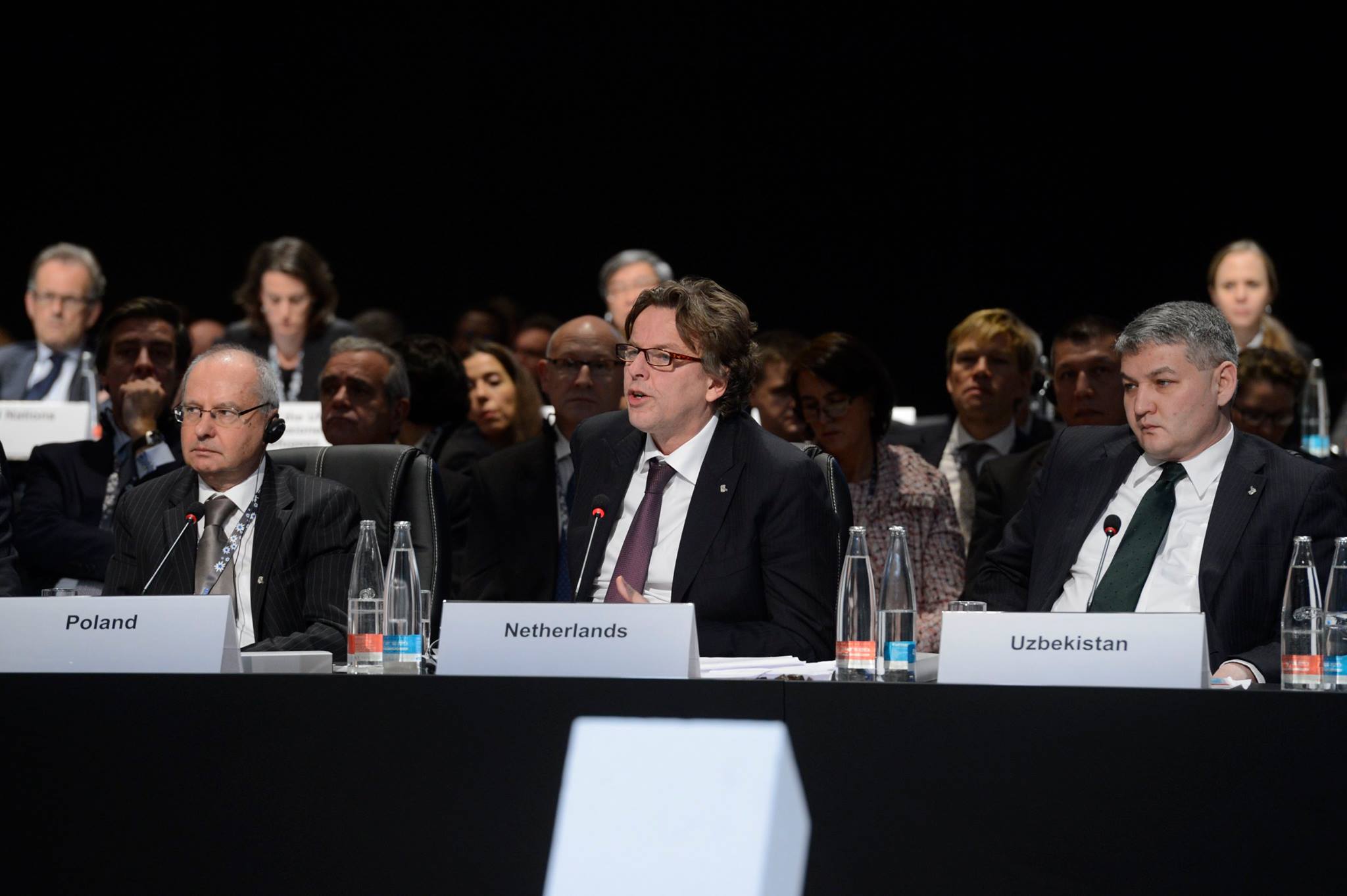
Adviesraad regering pleit voor hogere defensie-uitgaven

Het buitenlands- en veiligheidsbeleid van Nederland wordt geconfronteerd met een nieuwe werkelijkheid. Met het ingrijpen van Rusland in Oekraïne, de opmars van ISIS in Syrië en Irak en de desintegratie van Libië is aan de flanken van Europa een ‘gordel van instabiliteit’ ontstaan die een directe bedreiging vormt voor de veiligheid van Europa en dus ook van Nederland. Daarom adviseert de Adviesraad Internationale Vraagstukken (AIV) de regering het Nederlandse veiligheidsbeleid te herijken. Het is noodzakelijk de relatie met Rusland op een andere leest te schoeien, binnen de NAVO te pleiten voor versterking van de afschrikkingscapaciteit van het bondgenootschap, de politieke koers te richten op Duitsland, tijdens het Nederlandse EU-voorzitterschap prioriteit te geven aan Europese defensiesamenwerking, het defensiebudget drastisch te verhogen en de Nederlandse krijgsmacht selectief in te zetten. Dit stelt de AIV in een vandaag gepubliceerd advies ‘Instabiliteit rond Europa: confrontatie met een nieuwe werkelijkheid’.

De AIV is van mening dat voor langere tijd rekening gehouden moet worden met instabiliteit aan de oostgrens van Europa als gevolg van de Russische intimidatiepolitiek. De schaduw van de Russische militaire macht reikt over de oostgrenzen van Europa heen en een destabilisatie van de Baltische staten door Rusland is niet uitgesloten. De relatie met Rusland moet worden gebaseerd op een realistisch beeld van het land: Rusland maakt aanspraak op een positie van grote mogendheid in de wereld, streeft naar herstel van de vroegere Sovjetinvloedssfeer en ziet zichzelf niet als deelgenoot van de Europese samenwerking. De EU-lidstaten moeten voorkomen dat ze door Rusland uit elkaar worden gespeeld.

Volgens de AIV zal ook de instabiliteit in de Arabische regio en Noord-Afrika geruime tijd aanhouden. De westerse regeringen kunnen betrekkelijk weinig directe invloed uitoefenen en moeten zich naar de mening van de AIV beperken tot ondersteuning van gematigde Arabische regeringen en groeperingen. Alleen wanneer een humanitaire catastrofe dreigt of westerse veiligheidsbelangen rechtstreeks worden geraakt, komt militair ingrijpen in aanmerking.

De NAVO-lidstaten moeten werken aan de vergroting van het reactie- en voortzettingsvermogen van het bondgenootschap, zodat op een geloofwaardige wijze invulling wordt gegeven aan artikel 5 van het Noord-Atlantisch verdrag. Verder zijn forse investeringen in cybercapaciteit een absolute noodzaak. De Europese landen investeren te weinig in defensie en gedragen zich als free rider. Mede omdat de VS niet langer Europa maar Oost- en Zuidoost- Azië als de belangrijkste regio beschouwt, moet Europa eindelijk serieus werk gaan maken van de Europese defensiesamenwerking.

Nederland, dat vandaag slechts 1,16% van het nationaal inkomen aan defensie besteedt, moet een inhaalslag plegen. Jarenlang was het defensiebudget sluitpost bij formatie-en begrotingsbesprekingen. Een kwart eeuw bezuinigingen hebben een forse aanslag gepleegd op de inzetbaarheid, het voortzettings- en het escalatievermogen van de krijgsmacht. Een ‘Deltaplan-krijgsmacht’ moet zorgen voor én herstel van al het ‘achterstallig onderhoud’ én voor de broodnodige nieuwe investeringen. Daarom pleit de AIV voor een stapsgewijze verhoging van het defensiebudget naar het Europese gemiddelde van 1,6% van het bruto binnenlands product (BBP), zonder overigens de NAVO-norm van 2% BBP los te laten.

De AIV constateert een versnippering in de deelname van Nederland aan vredesoperaties over de laatste jaren. De regering zou er goed aan doen de krijgsmacht in beginsel alleen in te zetten ter vermindering van de instabiliteit aan de flanken van Europa en niet in gebieden verder weg. De instabiliteit rond Europa dwingt Nederland tot een strategische herpositionering. De AIV adviseert de regering in het voortraject van Europese besluitvorming per geval aansluiting te zoeken bij één of meerdere grote lidstaten om tijdig invloed te kunnen uitoefenen. Een sterke politieke gerichtheid van Nederland op Duitsland ligt voor de hand. Nederland zou Duitsland moeten aanmoedigen ook op veiligheidsgebied een meer geprononceerde positie in te nemen.

(persbericht Adviesraad Internationale Vraagstukken, 30 april 2015)

Geplaatst in Defensie, Rusland, Russian Federation | Tags: , , | Plaats een reactie

‘Wankele wereldorde vergt leger met grotere slagkracht’

Europese NAVO-landen besteden gemiddeld 1,6 procent van hun bnp aan Defensie. Wij lopen uit de pas met 1 procent, betogen Dick Berlijn, Jaap de Hoop Scheffer, Jan Pronk en vele anderen.

Door Jan Pronk, Jaap de Hoop Scheffer, Dick Berlijn
23 april 2015

Veiligheid en vrede in Europa zijn niet vanzelfsprekend. Verhoudingen zijn verslechterd, de toekomst is onzekerder. Crises in Oekraïne, het Midden-Oosten en Afrika en terroristische dreigingen zijn geen randverschijnselen, maar hebben directe gevolgen voor onze veiligheid en voor de samenlevingen van de Europese landen. Dit vraagt van Nederland een actief buitenlands- en veiligheidsbeleid en de bereidheid de kosten te dragen. Dat geldt ook voor de krijgsmacht, die in staat moet zijn de militaire taken op zich te nemen voor de verdediging van onze veiligheid en voor de handhaving en bevordering van de internationale rechtsorde.

De werkelijkheid is dat de bezuinigingen op Defensie van de afgelopen vijfentwintig jaar te ver zijn doorgeschoten. Onze krijgsmacht heeft grote moeite haar grondwettelijke taken te vervullen. De internationale toestand maakt dat er alleen maar meer eisen aan worden gesteld. Dat wil allerminst zeggen dat instabiliteit en crisis bij voorkeur met militaire middelen moeten worden opgelost. Militaire interventie ondersteunt de politieke inspanningen. Na de Koude Oorlog is er drastisch bezuinigd op Defensie. De omvang is verkleind van meer dan 100.000 militairen tot ongeveer 40.000. Het aantal infanteriebataljons (inclusief mariniers) ging van 17 naar 9. Het aantal fregatten werd verminderd van 15 naar 6. Tanks zijn afgeschaft. Het aantal gevechtsvliegtuigen wordt gereduceerd van meer dan 200 naar straks 37 F-35 toestellen; dan zijn niet meer dan vier toestellen beschikbaar voor langdurige inzet in internationale operaties. Ook vele andere capaciteiten werden verkleind.

Het defensiebudget, nu ongeveer 8 miljard euro, is sterk afgenomen als percentage van het bruto binnenlands product (bbp), nu net boven 1 procent; wanneer we pensioenen en wachtgelden ervan aftrekken, is het percentage 0,9 van het bbp. Het gemiddelde van de Europese NAVO-landen is 1,6 procent van het bbp. Na de reductie in de jaren negentig werden er de afgelopen tien jaar nog eens 22.000 banen geschrapt; in deze kabinetsperiode vervallen er 1000. De investeringsquote is de afgelopen vijf jaar gekelderd van ruim 20 tot 13,5 procent in 2013. Sinds de jaren negentig zijn de defensie-uitgaven bijna gehalveerd als deel van de rijksoverheidsuitgaven: nu nog 5 procent, terwijl op vrijwel alle terreinen de uitgaven groeiden.

Ondanks de bezuinigingen is het expeditionaire karakter van de krijgsmacht wel versterkt, onder meer dankzij doelgerichte materieelinvesteringen en modernisering van personeelsbeleid. Nederland heeft belangrijke bijdragen geleverd aan militaire missies, die internationaal werden gewaardeerd. Maar per saldo is de inzetbaarheid, de gevechtskracht en het uithoudingsvermogen van de krijgsmacht fors gedaald.

De in 2013 verschenen nota ‘In het belang van Nederland’ meldt dat op land eenmalig een samengestelde taakgroep van brigadeomvang, een maritieme taakgroep van vijf schepen, en een groep van acht jachtvliegtuigen kan worden ingezet. Sinds de jaren negentig is de Nederlandse ambitie wat betreft langdurige deelname aan vredebewarende operaties met een eenheid van bataljonsgrootte verminderd van vier naar één. De Nederlandse krijgsmacht verdient een beter fundament, en tegelijkertijd meer armslag om de eisen die er de komende decennia aan worden gesteld te vervullen. Daarom kunnen de volgende conclusies worden getrokken:

1
Er is een herwaardering noodzakelijk van het Nederlandse veiligheids- en defensiebeleid. Dat betreft versterking van de Nederlandse krijgsmacht, maar ook vergroting van de inspanningen voor conflictvoorkoming, diplomatie, conflictoplossing, en wederopbouw en staatsvorming in fragiele staten.

2
De inzetbaarheid, het expeditionaire karakter, het uithoudingsvermogen en de slagkracht van de Nederlandse krijgsmacht moeten worden vergroot. Dit betreft het op niveau brengen van de exploitatiebudgetten, versterking van de ondersteunende logistieke voorzieningen, strategisch transport, vervoermiddelen te velde (waaronder transporthelikopters), vergroting van de voorraden reservedelen, ict, etc.

3
De krijgsmacht moet een hoger ambitieniveau aankunnen: soms is het nodig dat tegelijkertijd meer dan één militaire operatie wordt uitgevoerd. En er moet meer worden bijgedragen aan de binnenlandse veiligheid. Bij dit alles moet veel aandacht worden besteed aan de doorontwikkeling van nieuwe capaciteiten, zoals cyber, onbemande systemen, en voor investeringen en arbeidsvoorwaarden.

4
Nog sterker dan tot dusver moet worden ingezet op internationale defensiesamenwerking.

5
Voor de beschreven doelstellingen moet het budget voor internationale veiligheid, diplomatie en defensie stapsgewijs structureel worden verhoogd, wat ons betreft met tenminste 1,5 miljard euro. Daarmee kan een eerste stap worden gezet om bestaande knelpunten in het veiligheids- en defensiebeleid op te lossen. Dan komt herstel van de inzetbaarheid van de krijgsmacht en een bescheiden vergroting en vernieuwing van de operationele capaciteit in zicht. Voor de middellange termijn moet het gemiddelde van de Europese NAVO-landen als doel gelden, 1,6 procent van het bruto nationaal product.

6
Voor de verhoging van het defensiebudget is een meerjarenperspectief nodig waarin Defensie voor de komende vijf à tien jaar een stabiele financiële grondslag krijgt. Dat kan alleen als afspraken worden gemaakt tussen politieke partijen over het niveau van de uitgaven voor veiligheid en Defensie, die zich uitstrekken tot in de volgende kabinetsperiode.

Met structurele verhoging van het budget voor veiligheid en defensie ontstaat het perspectief van een krijgsmacht die in de wankele wereldorde van vandaag en morgen weer zal zijn berekend op haar grondwettelijke taak.

De leden van de Initiatiefgroep: Harry J. van den Bergh, Dick Berlijn, Arend Jan Boekestijn, Lodewijk Casteleijn, Hans Hillen, Kees Homan en Gerrit Valk.

De medeondertekenaars: Yoeri Albrecht, Frits Bolkestein, Ben Bot, Hans van den Broek, Erik van Bruggen, Laurens Jan Brinkhorst, Patrick Cammaert, Ko Colijn, Boudewijn van Eenennaam, Afshin Ellian, Jaap de Hoop Scheffer, Mient Jan Faber, Frank van Kappen, Ruud Koole, Marnix Krop, Cor Lemstra, Frank Majoor, Ad Melkert, Eimert van Middelkoop, Alvaro Pinto Scholtbach, Jan Pronk, Onno Ruding, Uri Rosenthal, Felix Rottenberg, Paul Scheffer, Peter van Uhm, Gerdi Verbeet, Jack de Vries, Hans Wiegel, Rob de Wijk en Leon de Winter.

(Gepubliceerd in NRC Handelsblad, 23 april 2015)

Geplaatst in Defensie | Tags: , , | Plaats een reactie

Rusland in het AIVD-jaarverslag 2014

(Onderstaand de passages over Rusland in het jaarverslag over 2014 van de geheime dienst AIVD. Voor alle overige informatie: zie de link onderaan deze pagina).

Rusland ambieert grote internationale rol
Het sterke Russische geloof in de eigen status als grootmacht en het tegelijkertijd ontkennen van interne problemen zullen blijven zorgen voor instabiliteit. Het Westen is daarbij terug als gemeenschappelijke vijand en dient als zondebok voor economische tegenspoed of morele misstanden.

Om zijn invloed onder de bevolking te behouden, grijpt de president terug op vertrouwde controlemiddelen, waaronder uitbreiding van het staatsapparaat en een meer repressieve aanpak van politieke tegenstanders. Ook heeft Poetin de afgelopen jaren, ondersteund door een sterke propagandacampagne in de Russische massamedia, krachtig de nationalistische kaart gespeeld, die gekenmerkt wordt door een grote nadruk op patriottisme en het Russische orthodoxe geloof.

De uitspraken van president Poetin over de uitbreiding van de Russische invloedssfeer en zijn streven naar een internationaal bepalende rol voor Rusland staan in schril contrast met Ruslands kwetsbare positie. Die positie is kwetsbaar door een eenzijdige economische oriëntatie op de verkoop van ruwe grondstoffen.

Een ongelijk speelveld
Het Russische staatsbestel kenmerkt zich door grote bureaucratie. Bovendien ligt de werkelijke macht in Rusland niet bij de instituties die hier formeel voor verantwoordelijk zijn, maar is deze ingebed in parallelle machtsstructuren en rivaliserende informele netwerken. Dit stelt Poetin in staat om, achter de schermen en buiten formele instituties, als ultieme scheidsrechter op te treden. Deze Russische machtsstructuur, aangevuld met soms moeilijk te voorspellen beslissingen van Poetin met het doel zijn populariteit onder de bevolking zeker te stellen, zijn daarmee bepalend voor Ruslands politieke positionering. Dat maakt een transparante relatie met Rusland op zowel politiek als economisch vlak complex en afspraken met Rusland kwetsbaar.

Verdeeldheid als wapen
Ruslands belangrijkste politieke strategie om weerstand te bieden aan het Westen is het inspelen op Europese verdeeldheid. Dit was in 2014 vooral het geval op het vlak van de sancties die Europa instelde naar aanleiding van Ruslands rol in de crisis in Oekraïne. Op het energiedossier is dat al jaren de praktijk. Ook zal Rusland blijven proberen een wig te drijven tussen de NAVO-staten. Om de eensgezindheid van de Europese Unie inzake Rusland te verstoren voert het Kremlin voortdurend een verdeel-en-heersstrategie.

Het ‘energiewapen’ vormt een centraal middel om verdeeldheid te zaaien in Europa. Rusland beoogt individuele Europese lidstaten politiek aan zich te binden door hen eenzijdig afhankelijk te houden van Russisch aardgas, of juist door hen gunstige voorwaarden te bieden. Moskou hoopt dat deze landen zich tegen de Europese consensus over een stevig Ruslandbeleid keren en zich zullen verzetten tegen het Europese energiebeleid. Dit energiebeleid wil de vrije markt stimuleren door zich bij de keuze van energievoorziening niet te richten op één bepaald land, één bepaalde leverancier of een eenzijdige energiebron. Rusland, dat alles graag in één hand houdt, ziet dit beleid als een directe bedreiging voor zijn machtspositie.

De capaciteit van Rusland om politieke invloed uit te oefenen op basis van zijn positie als energiegrootmacht is echter verzwakt. Rusland heeft internationale samenwerking en investeringen nodig om de efficiëntie van de Russische energiesector te verhogen en de grote voorraden in de Arctische regio te kunnen ontginnen. Om zijn onafhankelijkheid ten opzichte van Europa aan te tonen, probeert Rusland daarom zijn energiehandel met China te intensiveren. Zo tracht Rusland zijn onderhandelingspositie ten opzichte van Europa te versterken.

(…)

Spionage
Staten gebruiken inlichtingendiensten om in het buitenland informatie te bemachtigen die niet vrij beschikbaar is en die hen voordeel kan verschaffen. Het kan gaan om informatie ter bevordering van hun eigen nationale veiligheid, zoals politieke inlichtingen, of om wetenschappelijke en economische (voor)kennis voor het eigen gewin. Nederland is met zijn hoogwaardige kenniseconomie, zijn goede positie in internationale organisaties en als geografisch en digitaal knooppunt in Europa een aantrekkelijk doelwit voor spionage door vreemde mogendheden.

Staten schermen hun inlichtingenactiviteiten zoveel mogelijk af. Daardoor is niet zomaar duidelijk wie hier spioneert. In het algemeen kan worden gesteld: hoe groter de mogendheid, des te groter de mogelijkheid van spionage door een staat.

Rusland
Veel van de huidige machthebbers in Rusland, inclusief president Poetin, zijn afkomstig uit de Russische inlichtingen- en veiligheidsdiensten. Voor hun informatiebehoefte en de uitvoering van de politieke en economische agenda vallen deze bestuurders grotendeels terug op de geheime diensten. De Russische inlichtingen- en veiligheidsdiensten worden dan ook wereldwijd ingezet voor het verzamelen van vertrouwelijke informatie en geheime inlichtingen, het verwerven van militaire technologie en het uitvoeren van beïnvloedingsoperaties, ook in Nederland.

De structurele aanwezigheid en activiteiten van de Russische inlichtingen- en veiligheidsdiensten in Nederland, gecombineerd met de wereldwijde Russische operaties gericht tegen het Westen, tasten de politieke, militaire en economische positie van Nederland en zijn bondgenoten aan.

Verwerving van kennis
In het afgelopen jaar is wederom vastgesteld dat de Russische inlichtingendiensten in Nederland agenten aansturen voor het verkrijgen van politieke en wetenschappelijke inlichtingen. Ook worden agenten ingezet voor de aanschaf van (semi)militaire technologie waarbij doelbewust exportrestricties worden omzeild. In Rusland schuwen de Russische diensten niet om over te gaan tot intimidatie van Nederlanders daar, met als doel informatie te vergaren.*

Beïnvloeding
De wereldwijde Russische campagne om beleid en beeldvorming ten aanzien van Rusland te beïnvloeden raakt ook Nederland. De Russische inspanning op het gebied van beïnvloeding lijkt mondiaal en ook in Nederland, geïntensiveerd na de interventie in Oekraïne. Rusland maakt hierbij deels gebruik van een contactennetwerk dat in de jaren daarvoor is opgebouwd. Rusland heeft veel kennis en ervaring, met name vanuit de inlichtingen- en veiligheidsdiensten, op het gebied van beïnvloedingsoperaties.

Beïnvloedingsactiviteiten zijn veelal gericht op het politieke en zakelijke domein maar ook op cultuur en media. De AIVD constateert in dit kader bijvoorbeeld een toename van de Russische inspanningen om talentvolle academici en maatschappelijk betrokken jongeren op kosten van de Russische overheid naar Rusland te laten reizen.

Heimelijke of verborgen (politieke) beïnvloeding laat zich moeilijk duiden omdat het plaatsvindt in een schemergebied tussen diplomatie en inlichtingenwerk en het uiteindelijke effect van beïnvloeding zich niet objectief laat meten. Bovendien bestaat er binnen de Nederlandse overheid, maar ook binnen het bedrijfsleven, een groot vertrouwen in de eigen weerbaarheid tegen dergelijke Russische campagnes. Dit kan leiden tot onderschatting van het effect van ongewenste Russische beïnvloeding op de lange termijn.

(…)

* Tegenover het NOS-Journaal lichtte AIVD-hoofd Rob Bertholee dit toe. “Je moet er achter zien te komen wat de zwakke punten zijn van de mensen die je interessant vindt. Op het moment dat je dat gevonden hebt, en het gaat bijna altijd om geld of om seks – seks, drugs en rock & roll zou ik bijna zeggen – dat is een beetje waar de zwakke plekken van de mensen zitten en die worden uitgebuit.” (bron)

Ga naar het jaarverslag 2014 

Geplaatst in Intelligence, Russian Federation | Tags: , , , , , , , , , , , , | 1 reactie

Why Russia Will Send More Troops to Central Asia

April 11, 2015

Summary
Russia is making a concerted effort to increase its military and security presence throughout Central Asia, just not for the reasons it would have you think. Though the Kremlin is concerned with the threat of spillover violence from Islamist militancy in Afghanistan — its purported motive for deploying more troops — it is far more alarmed by what it sees as Chinese and Western encroachment into lands over which it has long held sway. It is this concern that will shape Moscow’s behavior in Central Asia in the years to come.

Analysis
Central Asia has played an important role in the projection of Russian military power since the Russian Empire’s expansion in the 18th and 19th centuries. During this period, Russia established military outposts as it competed with the British Empire for influence in the region. By the mid-19th century, Russia had brought modern-day Kazakhstan, Uzbekistan, Turkmenistan, Kyrgyzstan and Tajikistan into its empire. In the early 20th century, the countries were incorporated into the Soviet Union.

After the collapse of the Soviet Union, Russia retained a military presence in Central Asia and played a major role in regional conflicts, such as the 1992-1997 Tajik civil war. Today Russia still has military bases in Kyrgyzstan and Tajikistan. Kazakhstan is a member of the Collective Security Treaty Organization, a military bloc dominated by Moscow. And while Uzbekistan and Turkmenistan are not members of the bloc, they do have important security and military ties with Russia through arms purchases.

Concerns of Militancy
Russia’s long-standing influence in Central Asian military affairs frames several of the country’s recent moves. On April 2, the base commander of Russia’s 201st military base in Tajikistan said Russia would increase the number of troops stationed there from 5,900 to 9,000 over the next five years and add more military equipment through 2020. Then on April 3 an unnamed source in the General Staff of the Russian armed forces told Kommersant that Russia was prepared to grant Tajikistan $1.2 billion in military aid over the next few years. Russian military specialists were reportedly dispatched to Turkmenistan’s border with Afghanistan on March 24 as well. Turkmen officials have yet to confirm this, but local media report that Ashgabat requested Russian assistance to protect the Afghan border.

russia_military_bases_tajikistan (1)

Officially, these developments are tied to growing concern over violence spilling over from Afghanistan into Central Asia. It is a legitimate fear for many Central Asian governments as NATO and the United States draw down their forces in Afghanistan. Regional governments have voiced discomfort with the increased militant presence in northern Afghanistan, including the Taliban and the Islamic State.

Russia has echoed this fear. Russian President Vladimir Putin’s special representative for Afghanistan alleged that Islamic State fighters in the north are training thousands of militants near the Tajikistan and Turkmenistan borders. Collective Security Treaty Organization summits have focused on the issue, and Tajikistan urged the bloc to do more to counter the threat at the April 1-2 Dushanbe summit.

Despite a definite uptick in militant attacks in northern Afghanistan, no concrete evidence has emerged of attacks over the border in Central Asian states. Central Asia’s last major wave of regionwide militancy was 1999-2001, when the Islamic Movement of Uzbekistan conducted attacks in the Fergana Valley in Tajikistan, Kyrgyzstan and Uzbekistan. The U.S. intervention in Afghanistan following 9/11, however, wiped out much of the group. Surviving elements then dispersed throughout the Afghanistan-Pakistan border area.

Since then, Uzbekistan, Tajikistan and Kazakhstan have seen some attacks by Islamist militants. But many were related to political dynamics, not the movement in Afghanistan. A spillover of Afghan militancy is possible, but so far the threat is minimal.

More Pertinent Factors
Because Islamist spillover from northern Afghanistan is still a relatively minor threat, Russia’s push into Central Asia may have other motivations. Moscow is engaged in a tense standoff with the West over Ukraine, just one theater in the competition for influence along the former Soviet periphery. Central Asia is another key region in this contest. The region possesses sizable oil and natural gas resources that are attractive to the European Union as it seeks to diversify energy supplies and end its dependence on Russia. Europe has already pursued Turkmenistan to join the Trans-Caspian pipeline project.

The United States has also been active in Central Asia, particularly from a security standpoint. The United States no longer uses Central Asian military bases that had been logistical centers for operations in Afghanistan, such as the Kant Air Base in Kyrgyzstan or the Karshi-Khanabad Air Base in Uzbekistan. These bases, however, have left a regional legacy. Washington maintains some security operations that include counternarcotics training with Kyrgyzstan and Tajikistan.

The United States has also expressed interest in increasing its commitment. The commander of U.S. Central Command, Gen. Lloyd Austin, said the United States was willing to provide military equipment and technology to support Turkmenistan’s efforts to secure its border with Afghanistan. The United States also announced in January that it would grant over 200 Mine Resistant Ambush Protected vehicles to Uzbekistan previously used in the U.S. Northern Distribution Network in Afghanistan. Such gestures point to a U.S. desire to develop more cooperative security relationships with Central Asian states.

Moscow’s military and security expansion efforts stem partly from its concern about these gestures. But Russia has not limited itself to deploying military personnel. Moscow has expanded the scope and membership of its Eurasian Union to include broader cooperation on issues including border controls. Kazakhstan is already a member, and Kyrgyzstan will soon join. Russia increased the number of exercises held by Collective Security Treaty Organization members. It also called on Uzbekistan and Turkmenistan to cooperate more with the security bloc, though both have been hesitant.

However, Moscow’s ability to solidify its position in Central Asia will be limited. Russia has a weak economy. Already, many Central Asian migrants who once worked in Russia have left, causing a decline in Russian remittances to the region. The West, and particularly the United States, will continue to have influence in the region. China, too, will continue to make economic and energy inroads.

Meanwhile, instability in the region will probably increase. Kazakhstan and Uzbekistan both have potential succession crises in the offing. Moreover, demographic growth and competition over water resources are likely to threaten the region’s security. Russia will see its position in Central Asia tested in the coming years. Islamist militancy is just one concern among many for Moscow and Central Asian governments.

Why Russia Will Send More Troops to Central Asia is republished with permission of Stratfor

Geplaatst in Russian Federation | Tags: , , | Plaats een reactie

Mali: Sjaak Rijke bevrijd door Franse commando’s

Bericht van het Franse ministerie van Defensie:

Mise à jour : 06/04/2015 12:13
A 5 heures ce matin, à l’extrême-nord du Mali, une action militaire a été conduite par les forces spéciales de l’armée française pour libérer l’otage néerlandais Sjaak RIJKE, enlevé à Tombouctou le 25 novembre 2011 par un groupe terroriste. Par ailleurs, cette action de combat a permis la capture de plusieurs individus.

La libération de M. RIJKE vient rappeler la détermination sans faille de la France à lutter contre les groupes terroristes armés dans la région du Sahel, dans le cadre de l’opération BARKHANE.

M. RIJKE a été évacué et mis en sécurité à Tessalit, sur la base temporaire avancée de l’opération BARKHANE. Il est sain et sauf.

En cette matinée de soulagement pour la famille et les compatriotes de l’ex-otage, le ministre de la Défense adresse ses félicitations aux militaires français qui ont permis le succès de cette nouvelle opération. Jean-Yves LE DRIAN s’est entretenu avec son homologue Jeanine HENNIS-PLASSCHAERT pour lui annoncer la fin de la captivité de son compatriote. A la première heure ce matin, le ministre des Affaires étrangères et du Développement international, Laurent FABIUS, a également averti son homologue Bert KOENDERS.

Depuis un an, 500 militaires néerlandais participent à la stabilisation et à la sécurité du Mali dans le cadre de la MINUSMA (Mission Multidimensionnelle Intégrée des Nations Unies pour la Stabilisation au Mali).

« La France poursuivra ses actions contre-terroristes au Sahel aussi longtemps que notre sécurité sera menacée par ces groupes. Aux côtés de nos cinq alliés et partenaires dans la région, les 3000 militaires de l’opération BARKHANE reçoivent ce matin le soutien et les félicitations de toute notre nation », déclare Jean-Yves LE DRIAN.

(Bron)

Sjaak Rijke

Sjaak Rijke in gevangenschap

Geplaatst in Mali, Terrorisme | Tags: , , , , , , | Plaats een reactie

‘Official’ biography of Taliban leader Mullah Omar

The Taliban movement of Afghanistan has published the first biography of its founder and leader, Mullah Omar. Here is the integral text of this document. 

Commemorating the nineteenth anniversary of the historical gathering and selection of Ameer-ul-Momineen on 4th April 1996 in Kandahar

Created On Saturday, 04 April 2015 00:19

Commemorating the nineteenth anniversary of the historical gathering and selection of Ameer-ul-Momineen on 16th Aries 1375 AH (solar) i.e. 4th April 1996 in Kandahar

The biography of the leader of Islamic Emirate Ameer-ul-Momineen, Mullah Mohammad Umar ‘Mujahid’ (May Allah safeguard him).

16th of Aries 1375 AH (solar) i.e. 4th April 1996 AD is a momentous day in the history of our Muslim people. Nearly two decades ago on this same faithful day, one thousand and five hundred scholars, dignitaries and Jihadi leaders of Afghanistan approved Mullah Mohammad Umar ‘Mujahid’ as the leader of the Islamic Emirate, gave an oath of allegiance to him and conferred the title of ‘Amir-ul-Momineen’ on him i.e. leader of the pious believers.

In the official almanac of the Islamic Emirate, this day has its own significance due to that historical event which subsequently is being commemorated by the Cultural Commission of the Islamic Emirate by publishing special articles and essays on this auspicious occasion.

As the publication of an inclusive biography of the leader of the Islamic Emirate was the urgent demand of our numerous colleagues especially the writers and researchers, the Cultural Commission of the Islamic Emirate decided to commemorate that historical occasion by publishing a comprehensive biography of His Excellency, the Amir-ul-Momineen, Mullah Mohammad Umar ‘Mujahid’ (may Allah safeguard him).

For the prevention of false propaganda by a number of spurious writers, analysts and some biased circles and to depict a clear picture to the writers and ordinary people, we draw the life-sketch of His Excellency, the Amir-ul-Momineen, in the following lines.

His Birth and early growth:
Mullah Mohammad Umar ‘Mujahid’, son of Moulavi Ghulam Nabi, grandson of Moulavi Mohammad Rasool and the great grandson of Moulavi Baaz Mohammad was born in 1339 AH (solar) i.e. 1960 AD in a religious and learned family of Chah-i-Himmat village of Khakrez district in Kandahar province of Afghanistan. His father, Moulavi Ghulam Nabi (late) was also born in Khakrez district and had received his early education in the traditional religious institutions and circles of this area. He was a well-known and respected erudite and social figure among the masses due to his indefatigable efforts in educating and guiding the people to the right path of Islam.

Two years after the birth of Mullah Mohammad Umar ‘Mujahid’, his father migrated from Khakrez district to Noday village of Dand district of this same province and remained there till his last in spreading religious education among the local people. He died in 1344 AH (solar) i.e. 1965 AD in that area and was laid to rest in the old famous graveyard of Taliban in Kandahar city.

After the death of his father, Mullah Mohammad Umar ‘Mujahid’ shifted at the age of five along with his family members from Dand district of Kandahar province to Deh-Rawud district of Uruzgan province where he started his early life under the supervision of his uncles Moulavi Mohammad Anwar and Moulavi Mohammad Jumma.

His Early education:
At the age of eight, Mullah Mohammad Umar ‘Mujahid’ joined the primary madrassa of Shar-i-Kohna area in Deh-Rawud district to get religious education. This madrassa was supervised by his uncle, Moulavi Mohammad Jumma and Mullah Mohammad Umar ‘Mujahid’ also started his early education from him.

Both of his uncles, particularly Moulavi Mohammad Anwar, played a key role in his religious teaching and training.

Mullah Mohammad Umar ‘Mujahid’ successfully completed his primary and middle level education from this madrassa. While eighteen, he started acquiring the traditional higher religious studies in the region but could not complete them due to the malicious communist coup d’état in 1978 AD in Afghanistan.

His Family:
Mullah Mohammad Umar ‘Mujahid’ belongs to the ‘Tomzi’ clan of ‘Hotak’ tribe which comprises a large part of Pashtuns which has delivered eminent Islamic statesmen, national and Jihadi heroes like the legendary Islamic figure of ‘Haji Mirwais Khan Hotak’.

Great Ghazi Haji Mirwais Khan Hotak (may Allah bless him), who is remembered with the venerated title of ‘Mirwais Nika’ (i.e. Mirwais, the grandfather) by Afghans, liberated Afghanistan from the tyranny of ‘Safavid’ dynasty in 1712 AD and laid down the foundation of a sovereign and independent Islamic state for Afghans.

Professionally, the family of Mullah Mohammad Umar ‘Mujahid’ comprises of scholars and teachers of religious studies. They devoted all their lives to serving the sacred religion of Allah Almighty, to promoting religious knowledge and to educating the Muslim masses ideologically. Therefore they were deeply admired in their area and spiritually, they were considered the most dignified and social figures of the society.

The birth of Mullah Mohammad Umar ‘Mujahid’ in such a spiritual and learned family and his upbringing under the direct patronage of his well-educated and ideological patrons deeply cultivated in him the ability to grow as a sincere Mujahid, a compassionate and vigilant Islamic and national figure who could emancipate the Afghan society from tyranny, corruption and injustice and preserve our beloved homeland (Afghanistan) from the imminent danger of disintegration.

His brothers, uncles and all other family members are ‘Mujahidin’ and four of his family members have already sacrificed their lives as martyrs in the path of Allah Almighty. Mullah Mohammad Hanafia, the uncle of Mullah Mohammad Umar ‘Mujahid’ was the first one who was martyred on 7th October 2001, the starting date of the brutal bombardment of American invaders.

His Jihadi struggles:
Mullah Mohammad Umar ‘Mujahid’ was in his early twenties when the communists usurped control of Afghanistan through a bloody military coup d’état. It was a time when it became nearly impossible for Mullah Mohammad Umar ‘Mujahid’ like all other heedful students to continue their studies as the starting encounter of atheist communists was against the scholars, Taliban, students and other Muslim intellectuals throughout the country. At that time, Mullah Mohammad Umar ‘Mujahid’ decided to abandon his higher studies unfinished. He left madrassa and turned towards Jihadi front to discharge his religious obligation.

He started his Jihadi struggle under a well-known Jihadi organization of ‘Harkat-i-Inqilaab-i-Islami’ (Islamic Revolutionary Movement) in Deh-Rawud district of Uruzgan province. After spending a while in this district, he earned a reputation for being a valiant Jihadi figure who played an active role in several military operations against the communists in various parts of that district. Due to his Jihadi prominence and a successful role in various Jihadi operations, he used to get the unanimous consent of all the Mujahidin of different parts and groups to be their commander in Deh-Rawud district for leading large-scale offensives against the enemy and he executed exceptionally successful operations in which he was wounded several times. He participated in many confrontations for more than three years along with his local Mujahidin against the invading Russians and their internal communist puppets.

The companions and commanders of his Jihadi front say that Mullah Mohammad Umar ‘Mujahid’, in-spite of being young, was efficient enough to discharge any responsibility or task as he was bestowed with strong physical composition and potency.

Later in 1983 AD, he went to ‘Maiwand’ district of ‘Kandahar’ province along with his Jihadi colleagues for the better co-ordination of Jihadi activities and continued his armed struggle against the Russian invaders and their internal stooges under the leadership of famous Jihadi commander ‘Faizullah Akhunzada’ who belonged to ‘Harkat-i-Inqilab-i-Islami’ (The Islamic Revolutionary Movement), one of the seven well-known Jihadi organizations of that time. Due to his successful role as a local Jihadi commander in numerous Jihadi operations and his efficiency and distinction in military tactics, he drew the attention of the then Jihadi organizations and eventually, he was permanently given the responsibility of a Jihadi front through ‘The Islamic Revolutionary Movement’ headed by (late) Moulavi Mohammad Nabi Mohammadi.

From 1983 to 1991, Mullah Mohammad Umar ‘Mujahid’ executed very successful operations in the suburbs of ‘Maiwand’, ‘Zhari’, ‘Panjwai’ and ‘Dand’ districts of Kandahar province which were vital Jihadi centers and Mujahidin used to be involved in fighting the enemy on a daily basis. Similarly he personally and directly participated in several victorious operations against the Russian invaders on the main ‘Kabul-Kandahar’ high way in the suburbs of ‘Shahr-i-Safa’ and ‘Qalat’ cities of Zabul province. His preferred weapon of choice was the ‘RPG-7’, which was simply called ‘Rocket’ among the local Mujahidin, as he was proficient and an expert in using this weapon. It is worth mentioning that ‘Maiwand’, ‘Zhari’ and ‘Panjwai’ districts of Kandahar province were areas of intense fighting during the Jihad against communism which turned the tide and brought about Russia’s defeat and withdrawal. Such a large number of tanks and other military vehicles were destroyed on the main ‘Kandahar-Herat’ highway that the enemy had erected walls made from these wreckages on both sides of the road to protect them from Mujahidin assaults.

Mullah Mohammad Umar ‘Mujahid’ was wounded four times in confrontational Jihadi operations against the Russians and in one of these operations, he lost his right eye.

Mullah Mohammad Umar ‘Mujahid’ was known as a prominent and distinguished Jihadi commander who played a crucial and decisive role in numerous Jihadi operations against the Russian invaders and their internal communist puppets in Kandahar and its neighboring provinces. In the following lines, we will mention some events and anecdotes by his Jihadi companions against the Russian invaders.

1. The enemy had a strong post inside Kandahar province which was known as ‘Budwan’ post. A military tank was stationed by the enemy at a strategic juncture near the post which created a great hurdle for the Mujahidin as it could target any line-of-fire easily. Mujahidin tried their best to destroy this tank but failed to succeed. Eventually Mullah Mohammad Umar ‘Mujahid’ was called in for help from ‘Sang-i-Hisaar’ area. He hit and destroyed this tank of ‘Budwan’ post with his ‘RPG’ rocket launcher which was a tremendous success for the Mujahidin at that time.
2. During the Holy Jihad against Russians in ‘Mahalla-Jaat’ area of ‘Kandahar’ province, Mullah Mohammad Umar ‘Mujahid’ was accompanied in a confrontation with the enemy by ‘Shaheed Mullah Ubaidulla Akhund’ who was later appointed the Defense Minister of the Islamic Emirate and the Deputy of ‘Ameer-ul-Momineen’ (i.e. the leader of the pious believers) after the American invasion. A large number of enemy tanks and other military vehicles were destroyed by them. The following day, visitors were bewildered and could not believe that the enemy was repelled. They thought that the enemy forces were still intact even though a large number of their vehicles were burnt and the remaining ones were pushed back to their previous locations.
3. A convoy of Russian military tanks was passing through ‘Sang-i-Hisaar’ area of ‘Zhari’ district on the main ‘Kandahar-Herat’ highway. Mullah Mohammad Umar ‘Mujahid’ was accompanied by ‘Mullah Biradar Akhund’ who later became the Deputy of the Islamic Emirate of Afghanistan, while they only had four RPG rounds. Unwavering they attacked the convoy and destroyed four military tanks with these rounds.
4. Mullah Biradar Akhund, a close friend of Mullah Mohammad Umar ‘Mujahid’ during the Holy Jihad era against the Russians, said that such a large number of Russian tanks were destroyed by him that his friends are unsure about its exact number.

In 1992, after the collapse of Najeeb’s communist regime and with the eruption of factional fighting throughout the country, like all other righteous Mujahidin, Mullah Mohammad Umar ‘Mujahid’ laid down his arms, set up a religious madrassa next to the mosque of ‘Haji Ibrahim’ in ‘Gishaan’ village of ‘Sang-i-Hisaar’ area in Maiwand district of Kandahar province and settled there. He restarted his unfinished religious studies along with some other Jihadi colleagues after a long and difficult fourteen year struggle.

This was a time when deadly factional fighting had engulfed the entire country including the capital city Kabul. Some factional warlords, purely for the sake of their personal interests, violated the objectives of the Holy Jihad against Russians and brought humiliation to the aspirations of one and a half million Afghan martyrs who sacrificed their lives for defending Islam and establishing an independent Islamic government in their beloved homeland.

Resistance against anarchy and founding the Islamic Emirate:
Instead of establishing an Islamic system of life in order to fulfill the long awaited aspirations of the whole Mujahid nation of our country, internal factional fighting broke out. The fact was that Mujahidin were weakened and sidelined through a pre-planned conspiracy. Some of the prominent communist figures who should have been trialed were unfortunately given shelter by some former Mujahidin commanders and some other warlords began looting, violating the people and plundering the country in an organized fashion.

In this way, the whole nation and country was plunged into a state of anarchy and lawlessness which was not experienced by the Afghans throughout their past history. The life, honor and property of all pious Muslims were endangered. Self made check-posts and barriers of stubborn, ignorant and brutal warlords were found on the main roads and thoroughfares of the country. Not only a wishful amount of money was demanded by these warlords from our poor countrymen but the honor and chastity of our already oppressed people was also at stake at these barriers. The national assets of our country, the achievements of previous Holy Jihad and even the jungles and other natural and mineral resources were relentlessly exploited by those warlords who were unprecedented in our history. Not only was the fruits of fourteen year Jihad against the Russians endangered but the daily life of ordinary people was also at stake.

Social corruption, killing, looting and plunder, oppressions, barbarism and the incessant sufferings of the Muslim masses were increasing daily due to the prevailing chaos and anarchy throughout the country. This situation deeply troubled righteous Mujahidin who had fought for the freedom, dignity and prosperity of the Muslim Afghan masses.

Mullah Mohammad Umar ‘Mujahid’ who was living along with Jihadi colleagues in Maiwand district of Kandahar province was also deeply anxious about the prevailing anarchy like all other true Mujahidin. He observed that numerous barriers were erected on the main ‘Kandahar-Herat’ highway and the oppressed passengers, women and white-bearded elders were looted, disgraced and even killed in the broad day light by ruthless warlords. It is worth mentioning that the number of illegal barriers and check-posts had increased to an extent that the traders, bringing their merchandise from ‘Herat’ province to the border town of ‘Boldak’ in Kandahar province, used to unload their goods in Maiwand district due to unlimited demands of these barrier-holders. Then they used to transfer their goods through unknown desert routs to their destination after suffering intolerable hardships.

Mullah Mohammad Umar ‘Mujahid’ and his colleagues were fully aware about the prevailing situation in Kandahar province where the brutal warlords were dispersed in each and every corner of the city. They were incessantly usurping the public as well as private properties and selling them for huge amounts of money. They erected their private markets on government lands. Moreover, they always used to fight among themselves on minor issues which caused great distress for the ordinary people.

These endless sufferings of the helpless and oppressed people of our country compelled the true and righteous Mujahidin to bond together and find a solution for protecting the lives, honor and properties of the Muslims. Mujahidin started meetings and counseling amongst themselves.

Mullah Mohammad Umar ‘Mujahid’ and his companions arranged their first meeting in ‘Zangawat’ area of Panjwai district in ‘Kandahar’ province involving the well-known and authentic local and regional Ulama (scholars). This gathering of Ulama headed by Moulavi Said Mohammad (known as Moulavi ‘Pasanai Sahib’), the arbitrator general of Mujahidin in Kandahar province during the Holy Jihad against Russians, told Mullah Mohammad Umar ‘Mujahid’ to stand and resist against this anarchy as he would be supported by all of them. This was the initial meeting of the Islamic Movement and Mullah Mohammad Umar ‘Mujahid’ laid down the foundation of his struggle against chaos and corruption on 15th Muharram 1415 AH (lunar) (i.e. 24th or 25th June 1994).

The Islamic Movement launched their struggle and fight against corruption and anarchy under the leadership of Mullah Mohammad Umar ‘Mujahid’ which was widely welcomed by the true and righteous Mujahidin and ordinary masses. First, they liberated Kandahar province and then other vast areas of Afghanistan from the corrupt and wicked warlords. At that time, when major parts of Afghanistan came under the control of Islamic Movement of Taliban, a large number of Afghan Ulama, comprising more than 1500 religious scholars, convened a meeting in Kandahar city on 15th Dhul Qa’da 1416 AH (lunar) (i.e. 4th April 1996). They approved the leadership of Mullah Mohammad Umar ‘Mujahid’ and conferred the title of ‘Ameer-ul-Momineen’ (the leader of the pious believers) on him. On 6th Libra 1375 AH (solar) (i.e. 27th September 1996), Kabul city, the capital of Afghanistan also came under the control of the Islamic Emirate of Afghanistan and subsequently, the supremacy of the Islamic Emirate prevailed in ninety five percent territory of our beloved homeland including all the central and northern parts of Afghanistan.

mullah omar1

Kandahar city, 4 April 1996. Mullah Omar shows the legendary ‘Cloak of the Prophet Mohammed’ to a large gathering of Islamic scholars  and in return receives the title of ‘Amīr al-Mu’minīn’ (Leader of the Faithful) . This is the only confirmed picture of Mullah Omar.

The Islamic Emirate of Afghanistan, under the leadership of Mullah Mohammad Umar ‘Mujahid’ established an Islamic system based on the sublime rules and principles of Sharia Law. After a long interval, the world witnessed a practical model of an Islamic government once again. He preserved the country from disintegration and disarmed the unruly warlords which resulted in the restoration of exemplary peace and stability in the country which was deemed unattainable by the whole world including the United Nations. But (and there is great ‘But’) the arrogant infidel powers of the world could not tolerate this Sharia system established by the Islamic Emirate which became a thorn of their eyes. Therefore they adopted and initiated antagonistic behaviour towards it. They tried their best either to find or create lame excuses to overthrow this system and eventually they launched a joint military invasion against it.

His charismatic personality:
As a leading personality, Mullah Mohammad Umar ‘Mujahid’ has a unique and charismatic personality. Contrary to high ranking officials and leaders, he does not want to show off or boast. He is not eager or excited to speak if it is un-necessary to do so. And if needed, his words and sentences are keen, perceptive and logical. For instance in the early days prior to the American invasion, wide range propaganda was launched to demoralize Mujahidin and oust the Islamic Emirate. The Americans left no stone unturned and all the western media outlets, their radio stations and popular television stations were fully devoted to promoting American malicious objectives.

But contrary to all these devious efforts and propaganda, he assured his own people in his simple, reasonable but self-confidence mode and tone and delivered the following message:

“Allah is Almighty. Whether it is America or a tiny ant, it makes no difference for Him. America and her allies should listen carefully that the Islamic Emirate is not like one of the previous regimes whose Ameer (head) would flee the country; as it happened in the case of King Zahir Shah, the former monarch of Afghanistan, who sought asylum in Rome; nor will my soldiers (personnel) surrender to you. You should remember that these are well-organized Jihadi fronts. If the capital and other cities of the country fall in your hand and the Islamic government is ousted, instead of surrendering, our Mujahidin will spread to the countryside and go to the mountains. What will you do then? Inevitably, you will be caught and killed everywhere just like the Russians.

You should realize that bringing chaos is very easy but its eradication and the restoration of law and order is a huge and strenuous task. Death is inevitable and all living creatures will have to die one day. Instead of dying without faith and dignity while supporting the Americans, wouldn’t it be better to die with faith and dignity in the service of Islam?”

Some people might not have understood these expressions of Mullah Mohammad Umar ‘Mujahid’ which were fraught with firm belief, devotion and sincerity but nearly fourteen years have elapsed since this huge one-sided battle was launched and the American super power, NATO alliance and other allied forces are on the verge of defeat by the empty handed but devotional and determined Mujahidin of Mullah Mohammad Umar ‘Mujahid’; those gentlemen might now have understood the simple but historic expressions of our leader.

Similarly at the beginning of the American invasion, he declared to the Afghan masses in a radio broadcasted speech while alluding to the foreign invaders and their internal stooges that weapons can bring death but it cannot defy it. This sentence might have been a meaningless and insignificant composition of words for some people but in the previous thirteen years, the implications of these simple words were practically observed when the brutal foreign invaders relentlessly killed a large number of innocent people with the help of their advanced technology and weapons of mass destruction but they could not turn death away from their own soldiers who are incessantly being killed, wounded and incarcerated for the last thirteen years by the heroic Mujahidin under the leadership of Mullah Mohammad Umar ‘Mujahid’.

It is an important fact that even the arrogant foreign invaders, who are fully equipped with all kinds of modern weapons and other facilities, plainly admit that thousands of their soldiers were killed and wounded inside Afghanistan in this futile war.

According to Mullah Mohammad Umar ‘Mujahid’, it is better to speak less and do more as our religion emphasizes deeds over words or ideas. His life is totally free from ceremonies and un-necessary protocols. He has adopted a simple and plain style in all aspects of his life. Simple dress, simple food, simple talk, frankness and informality are his natural habits. He does not stand on ceremonies and dislikes ceremonial people.

He considers determination, prudence and sincerity as the basis of all progress and the more prudent, sincere and decisive one is among his colleagues the more he is admired and loved by him.

Similarly he is used to facing hardships, sufferings and ups and downs of life. Whatever the magnitude and intensity of the tragedy or trouble might be, he remains tranquil and does not lose either temper or courage. During varying conditions of jubilation and jeopardy, triumph and failure, he remains serene and self-controlled.

He deeply respects scholars and other elders. Gravity of manner, dignity, modesty, reverence, reciprocal respect, sympathy, mercy and sincerity are his natural traits. Strong determination, trusting in only One Allah the Almighty and a strong belief in what is ordained by Him are the distinguishing features of his life.

This is the reason that Mullah Mohammad Umar ‘Mujahid’ is deeply loved and revered by his followers and Mujahidin which has nothing to do with his apparent worldly status. It has been nearly thirteen years that our beloved homeland Afghanistan is invaded and occupied by the brutal foreign invaders but his devoted and sincere Mujahidin follow his verbal and written commands and decrees as reverently as they did it in his presence and do not refrain from even sacrificing their lives to execute his orders.

His vigilance about the international and Islamic issues:
Mullah Mohammad Umar ‘Mujahid’, as the founder of the Islamic Movement of Taliban and a leader of the Muslims, is fully cautious and takes keen interest in all the issues relating to the Muslim Umma.

He has always defended the issue of Al-Aqsa Mosque (the first Qibla or prayer direction of early Muslims) and the vindicated claim of Palestinian Muslims. He has taken a clear stance and supported all issues of Muslims in all parts of the world. He considers it the duty and obligation of every Muslim to liberate the Al-Aqsa Mosque from the occupation of Zionist Jews.

Mullah Mohammad Umar ‘Mujahid’ feels pity and shares the sufferings of all Muslim people. His sincerity, sympathy, brotherhood and co-operation with the Muslim brothers of the world are not restricted only to slogans but rather he has proved it practically and in the real sense of all these terms.

His ideological association:
Ideologically, Mullah Mohammad Umar ‘Mujahid’ belongs to the main ‘Ahl-i-Sunna wal Jamma’a’ (the believers in Quran, traditions of the Holy Prophet, peace be upon him, and the consensus of Muslim Umma). He is the imitator of Hanafi school of thought.

He is severely opposed to all heresy or heterodox opinions. He never likes sectional, ideological and factional differences among the Muslims. He always recommends and insists on Islamic and ideological unity and co-operations to his followers and all other Muslims as the ideological unification among the Muslims is the utmost demand of this crucial time. Following the path of our pious predecessors and leading scholars in the light of Quran and Hadith (i.e. the traditions of our Holy Prophet, peace be upon him) is considered the only path of salvation by him for the Muslim Umma.

His personal life:
Mullah Mohammad Umar ‘Mujahid’ who has spent most part of his life in acquiring religious studies, Jihad, invitation and guidance towards Islam, might be the poorest person who has taken no personal advantage from ‘Bait-ul-mal’ i.e. ‘the public treasury of the Muslim state’ among the contemporary leaders of Afghanistan. He has not accumulated any wealth to spend on a luxurious life in the previous Jihad era against Russians by taking disadvantage of his personal influence, nor has he lived lavishly in the seven years reign of his overall control during the Islamic Emirate of Afghanistan.

Mullah Mohammad Umar ‘Mujahid’ even now does not own an ordinary residence neither has he any cash deposits in any foreign bank accounts. In 1999 when unilateral and ruthless economic sanctions were imposed by the United Nations on the oppressed people of Afghanistan and all the foreign bank accounts of Taliban leadership were frozen, Mullah Mohammad Umar ‘Mujahid’, the highest ranking official, being the head of the Islamic Emirate of Afghanistan, had no bank accounts either inside the country or outside nor anywhere else with any assumed name.

During the reign of the Islamic Emirate, when his residence came under the deadly attack of the brutal enemy which resulted in the martyrdom of his family members along with several other innocent people, some officials of the Islamic Emirate decided to build another residence and an office for the leadership of the Islamic Emirate in the north western part of Kandahar city, near the hill of ‘Baba Sahib’ for his safety purposes as there was no residential area in the suburbs of this location. This residence was also administered by the ‘Bait-ul-mal’ as one of its general properties therefore it too was not considered the private ownership of his Excellency.

In 1996 AD, when he was conferred with the title of ‘Ameer-ul-Momineen’ (i.e. the head of the pious believers), instead of showing excitement or jubilation, he bitterly wept as his shoulder sheet was completely soaked with his tears. At the end of that historical meeting, he told the Ulama present:

“You are the inheritors of the Holy Prophet (peace be upon him) and you have thrown a heavy responsibility upon my shoulders. In reality, you will be held responsible for my steadfastness as well as deviation from it.

O our teachers and respected scholars! If I could not discharge this huge responsibility of the Muslim masses in a proper way or deviate from it, you will have to guide me towards the right path in the light of your knowledge. If the Taliban do make mistakes in the implementation of Sharia and you do not guide them knowingly, you will have to bear the responsibility on the Day of Judgment.”

His nature and temperament:
Besides the natural silence of Mullah Mohammad Umar ‘Mujahid’, he is affable and has a special sense of humor as he never considers himself superior to his colleagues whatever their status might have been. He treats them cheerfully, cordially, compassionately and with reciprocal reverence. In most of his meetings, he usually speaks about Jihad.

His daily activities in the present circumstances:
In the present crucial conditions and regularly being tracked by the enemy, no major change and disruption has been observed in the routine works of Mullah Mohammad Umar ‘Mujahid’ in following and organizing the Jihadi activities as the leader of the Islamic Emirate. He begins his working day with the prayers to Allah Almighty and recitation of the Holy Quran. In free time, he studies various commentaries of the Holy Quran and traditions of the Holy Prophet (peace be upon him). He keenly follows and inspects the Jihadi activities against the brutal infidel foreign invaders. In organizing and reshuffling the Jihadi and military issues, he delivers his orders in a specific way to his Jihadi commanders. He regularly follows the Jihadi publications and other international media resources to judge his victories and likewise other issues against the foreign invaders. In this way, he remains in touch with the day to day happenings of his country as well as the outside world. These activities form his basic daily life in the present circumstances.

The Islamic Emirate under his leadership:
The Islamic Emirate of Afghanistan was established as an Islamic Movement under the leadership of Mullah Mohammad Umar ‘Mujahid’ on 15th of Muharram 1415 AH (lunar) (i.e. 24th June 1994) which subsequently passed through several crucial stages while enjoying the support thousands of scholars, Mujahidin and the pious masses of our country. It had the honor of implementing the Islamic Sharia in ninety five percent land of our beloved homeland. It is still controlling vast areas of the country and is involved in armed resistance against the infidel western invaders as a pure and lofty Islamic Emirate.

Mullah Mohammad Umar ‘Mujahid’ is still the leader in the present hierarchy of the Islamic Emirate of Afghanistan. His deputy, the leading council, judiciary, nine executive commissions and three other administration organs are active under his leadership which form the warp and woof of the present setup of the Islamic Emirate.

The deputy of the Islamic Emirate, besides inspecting and assessing all the subordinate organs, conveys their working reports to the ‘Ameer-ul-Momineen’ and communicates the orders and decrees of the leader to all the concerned organs and authorities. The leading council of the Islamic Emirate consists of twenty members who are appointed by the leadership and convene their meetings under the deputy of the Islamic Emirate. This council discusses and makes decisions about all political, military, social and other critical issues.

Judiciary of the Islamic Emirate has a separate and wide setup which comprises of primary courts, courts of appellation and court of cassation which are busy in discharging their own responsibilities.

To meet the needs of present circumstances, nine different commissions are set up in the present hierarchy of the Islamic Emirate. Due to ongoing Jihadi requirements, the largest one is the military commission which consists of nine sub-circles. This commission is responsible for appointing governors or military in-charges for all 34 provinces of Afghanistan, military in-charges of all districts, setting up sub-commissions which are subsequently responsible for all military and civil affairs of their respective provinces and districts.

The remaining commissions are as following:

Education and Training Commission
Commission of Political Affairs
Cultural Commission
Economic Commission
Health Commission
Invitation, Guidance and Amalgamation Commission
Commission of Prisoners’ Affairs
Commission for NGOs

The remaining organs of the Islamic Emirate are:

Organ for the Prevention of Civilian Casualties
Organ for Martyrs and Disabled People
Organ for Collecting and Organizing Special Revenues

The Islamic Emirate controls a major part of Afghanistan as a well-organized and working system for over two decades under the leadership of Mullah Mohammad Umar ‘Mujahid’ which has sincerely implemented the Islamic system of life in all areas of its jurisdiction. Law and order is restored; lives, honor and properties of the Muslim masses are safeguarded.

During this whole period of time, the Islamic Emirate has faced several challenges and adversities as the only active Islamic system of governance but it has successfully survived by the grace and benevolence of Allah Almighty through all these challenges and confrontations as it has proved its determination and steadfastness to its lofty principles throughout these adversities.

May Allah Almighty protect and safeguard our leader!

(Source)

Geplaatst in Afghanistan | Tags: , , , , , , , | Plaats een reactie

Russia Targets NATO With Military Exercises

Source: Stratfor

Summary
Russian military exercises, the latest in a series across the country, have taken on a threatening posture. While the most recent installment is not the largest exercise Russia has conducted, the areas involved and the forces included seem to have been deliberately chosen to send a warning to NATO; the exercise itself seems to simulate a full-scale confrontation with NATO through the forward deployment of nuclear armed submarines, theater ballistic missiles and strategic bomber aircraft. Strategic weapon systems, including assets that are part of Russia’s nuclear capabilities, have also been deployed to locations near NATO’s borders.

Analysis
According to Russian statements, the snap exercise, which was not announced before it began March 16, will last five days and will involve some 45,000 servicemen, around 3,000 vehicles, more than 40 surface vessels, 15 submarines and 110 aircraft. The more notable systems involved are the Iskander mobile theater ballistic missiles and fighter aircraft that are being deployed to Kaliningrad, Tu-22M3 long-range strategic bombers that are being deployed to Crimea, and ballistic missile submarines that have been sent to sea with protective escorts.

The initial statement on the exercise focused on the role of the Northern Fleet, saying the main purpose of the drill was to test deployment times to Russian positions in Novaya Zemlya and Franz Josef Land. Russia has increased its military presence in the Arctic, and the exercise highlights Russia’s plans for the Arctic region. This part of the drill seems to be playing out in a rather straightforward way: Russian forces are being airlifted to Russia’s Arctic bases and several naval exercises are taking place, including anti-submarine operations and mine sweeping procedures that typically precede the snap sorties of nuclear armed submarines in times of crises.

Actions Are Stronger Than Words
However, though the stated focus of the exercises is in the Arctic, operations have expanded to include military activities along the Finnish border, the deployment of strategic weapons systems to Kaliningrad and Crimea, and positions across the Baltic Fleet, Black Sea Fleet, and in the western and southern military districts. This combination lifts the exercise beyond a simple deployment of ground forces and naval exercises in the Arctic and forms a nuclear narrative.

The forward deployment of theater ballistic missiles and bomber aircraft are provocative indicators of possible pre-emptive action against NATO and Eastern Europe. Given Russia’s military actions in Ukraine, the possibility, however unlikely, that the country could expand operations cannot be dismissed. For that reason, and because Russia has intentionally designed the drills to mimic a potential conflict with Europe, the exercises are cause for alarm in Europe.

By deploying Tu-22M3 bomber aircraft, Russia is also openly invoking the threat of nuclear confrontation. Considering Moscow’s statements about a potential deployment of nuclear weapons to Crimea, Russia is clearly connecting the Ukraine crisis and its intentions in the Arctic to the nuclear deterrent it possesses.

Geographic Size Sets This Exercise Apart
The large geographic area this drill covers places it outside the usual pattern of other snap exercises conducted by Russia. It also puts it in the same areas where NATO has been conducting its exercises, including in the Baltics, Romania and Hungary. NATO’s most notable drills have been conducted under the U.S. Operation Atlantic Resolve, which has seen the rotation of a brigade-sized U.S. Army force and the arrival of armor and helicopters to support that deployment. Russia has noted increased U.S. surveillance flights over the Baltics and the expanded Baltic air policing operation that NATO conducts there.

russia_military_europe_2

An exercise including parts of the Russian military stretching from the Northern, Baltic and Black Sea fleets through the western and southern military districts is notable. Russia has conducted even larger exercises in the past. However, those have tended to focus on a particular military district or fleet, or a combination of closely related ones. Conducting this single exercise in the area stretching from Norway to the Baltics through Poland and into Crimea is clearly angled toward NATO and its Eastern European members.

Considering the military tensions surrounding the Ukraine crisis and its fragile cease-fire, these exercises are an aggressive signal, particularly since they immediately follow Putin’s mysterious disappearance last week. Russia has an interest in flexing its military muscle to remind everyone of the havoc it could wreak and to dissuade anyone from taking radical action in Ukraine. The United States has been careful when it comes to Ukraine, even delaying the deployment of 300 U.S. troops to western Ukraine as part of a training exercise. The United States maintains, however, that this deployment is still an option and could order it as early as April.

Beyond Ukraine, Russia is also responding to military exercise dynamics in Eastern Europe, where the Ukraine crisis has reverberated. A general increased tempo of Russia military activity (both in the sense of long distance strategic flights and large-scale military exercises), an increase in NATO presence and more exercises in Eastern Europe have resulted in a back and forth of military posturing reminiscent of Cold War shows of force.

In that context, Russia’s exercises serve as threats to the opposing forces, demonstrating capabilities and suggesting intent. But they are important military tools to the Russian military as well. To maintain readiness, actually executing operations or deployments through exercises is a must. Beyond that, Russian military planners need to have a realistic understanding of the capabilities of Russian forces. There is no better way to gain this understanding than to let those forces run through operations, or parts of them, to determine the basic parameters that are feasible. As Russia tests its own capabilities, it shows the rest of the world the type of operations and the military districts it considers key in its strategic planning.

Russia Targets NATO With Military Exercises is republished with permission of Stratfor.

Geplaatst in NAVO, Russian Federation | Tags: , , | Plaats een reactie

EUCOM 2015 Congressional Posture Statement

STATEMENT OF GENERAL PHILIP BREEDLOVE

COMMANDER
U.S. FORCES EUROPE

FEBRUARY 25, 2015
HOUSE ARMED SERVICES COMMITTEE
I. Introduction
It is an honor for me to lead the Soldiers, Sailors, Airmen, Marines and Civilians of the
U.S. European Command (EUCOM). Those assigned and deployed from the European theater sent into harm’s way, in Afghanistan and elsewhere, are particularly within the thoughts of the Command. I want to thank this Committee for all of the support it has offered them.
EUCOM has experienced dramatic changes in the security situation on the European continent over the last 12 months, forming a new European security environment. These changes have significant ramifications for U.S. national security interests and those of our European Allies and partners. As a result, we are assessing the threat to U.S. and NATO Allies in the theater and beyond. Even as we continue to lean forward with our NATO Allies and partners in response to the conditions in this new environment, fully addressing these growing challenges and their long-term implications requires a reformulation of the U.S. strategic calculus and corresponding resourcing levied towards Europe.
In the statement I submitted to this Committee last year, I described in detail how important our NATO Allies and non-NATO partners in Europe are to American safety and security – their importance is even greater today. EUCOM must be able to assure, deter, and defend against Russian aggression; support ongoing and future contingency operations; counter transnational threats; and help build our partners’ capability to help us accomplish these missions, thereby enhancing regional and global security.
Our many shared values, interests, and economic interdependence with Europe provides unique opportunities and assets for collective security as well as global security cooperation. The United States depends on our willing and capable Allies and partners throughout Europe to work with us to fully defend our national security interests and to respond to crises around the world. Time and again, our Allies and partners in Europe have proven essential to U.S. military operations by allowing us access, including bases, transit, and overflight rights for U.S. forces as well as providing enhanced legitimacy and operational capability through the participation of Ally and partner nation military forces in undertakings in Europe, around Europe and often far from Europe.
Maintaining our strategic Alliance with Europe is vital to maintaining U.S. national security and is not to be taken for granted. We must reassure our European Allies and partners through the United States’ commitment to NATO and the credibility of that commitment fundamentally rests upon the capabilities, readiness, and responsiveness of U.S. military personnel stationed in Europe. The forces assigned to EUCOM are the U.S.’s preeminent forward deployed force and fulfill the United States’ primary treaty obligation to NATO. Our permanent presence also allows us to maximize the military capabilities of our Allies. Permanently stationed forces are a force multiplier that rotational deployments can never match.
EUCOM must be a stabilizing force on multiple fronts. Nations on Europe’s Southern flank are concerned the focus on Eastern Europe may draw attention and resources away from their region, allowing for an unmonitored flow of foreign fighters, economic and political refugees, and unchecked illicit trafficking of goods and humans from an arc of instability stretching across large parts of northern Africa through the Middle East. In the Levant, persistent threats from other countries and non-state actors drives continued security concerns in Israel.
Multiple ongoing conflicts in the Middle East and Africa also require EUCOM to use its limited resources to support missions occurring in the U.S. Central Command (CENTCOM) and U.S. Africa Command (AFRICOM) areas of responsibility. EUCOM works closely with our bordering Combatant Commands to ensure there are no seams as we address issues crossing geographic boundaries, supporting CENTCOM and AFRICOM operations to protect U.S. national interests. Each of these security situations reinforces the importance of EUCOM and NATO to our long-term vital national security interests.
After years of force structure and other personnel reductions, fewer than 65,000 U.S. military personnel remain permanently stationed in Europe to secure and advance U.S. national interests from Greenland to Azerbaijan and from the Arctic to Israel. The size of our military presence forces difficult decisions daily on how to best use the limited resources we have to assure, stabilize, and support. I ask you for your support and favorable consideration of the U.S. role in addressing the new European security environment and helping me set the theater. As the Commander of EUCOM, Supreme Headquarters Allied Powers Europe (SHAPE) and Allied Command Operations for NATO, I support the goal of a Europe that is whole, free, at peace, and prosperous. It is with this in mind that I consider Europe’s current security situation.

II. Assessing the Threat
As mentioned, EUCOM is working within the framework of a new European security environment, focused on countering three primary security threats: Russian aggression in the East, foreign fighter flow between Europe and the Levant, and transnational threats stemming from North Africa.
A. Eastern Flank: Russia and Periphery
For almost two decades, the United States and Europe have engaged with Russia as a partner, seeking to build relationships militarily, economically, and culturally. In 1994, Russia became a Partnership for Peace member with NATO. That same year, Russia, the United States, and the United Kingdom signed the Budapest Memorandum, reaffirming commitments made by all parties under the Helsinki Final Act and the UN Charter to “respect the independence and sovereignty and the existing borders of Ukraine.” Under the 1997 Founding Act, NATO made a political commitment that, “in the current and foreseeable security environment,” the Alliance would carry out its collective defense and other missions without “additional permanent stationing of substantial combat forces.” In 2009, the United States sought to “reset” its relationship with Russia, which had been damaged by the 2008 Russian invasion of the Republic of Georgia. During this period, the Department of Defense made security and force posture determinations significantly reducing European force structure based on the assumption that Russia was a partner.
Despite these and many other U.S. and European overtures of partnership, Russia has continued to view its own security from a zero-sum point of view. Since the beginning of 2014, President Putin’s Russia has abandoned all pretense of participating in a collaborative security process with its neighbors and the international community. Instead, Russia has employed “hybrid warfare” (which includes regular, irregular, and cyber forms of war as well as political and economic intimidations) to illegally seize Crimea, foment separatist fever in several sovereign nations, and maintain frozen conflicts within its so-called “sphere of influence” or “near abroad.” Undergirding all of these direct approaches is the pervasive presence of the Russia propaganda machine, which inserts itself into media outlets globally and attempts to exploit potential sympathetic or aggrieved populations.
Russia uses energy as a tool of coercion. Many former-Soviet bloc and Eastern and Central European states have long been concerned about Russia’s intentions in Europe and they consider the Ukraine crisis the latest validation of their concerns. Recent Ukrainian and Russian energy negotiations show how Russian coercion threatens broader European cooperation as individual countries must weigh their own security and economic concerns. Russia’s coercion using energy has grown along with Russia’s threats and outright use of force.
As a result, there are growing security concerns among Central and Eastern European countries that are members of NATO and the European Union or are seeking closer ties with the trans-Atlantic community. Having already experienced the use of Russian military force in the 1990s and in 2008, Georgia is especially threatened by Russian occupation of Abkhazia and South Ossetia. The Baltic States have demonstrated their concern by increasing military interaction with U.S. and NATO forces, which has resulted in more U.S. and Allied forces in NATO’s Baltic Air Policing mission and the deployment of U.S. rotational ground forces to the Baltics and Poland to foster interoperability through training and exercises. U.S. Special Operations Forces training events were also initiated throughout the Baltics and Eastern Europe at the request of the host nations. We must continue to work with NATO to provide enduring support to the security of our Allies and partners in this area.
Russia views Ukraine as part of its sphere of influence, regardless of the views of the Ukrainian people. While Russia’s aggressive actions in Ukraine are the most current manifestation in a pattern of continuing behavior to coerce its neighbors in Central and Eastern Europe. Beyond its actions in Georgia and Ukraine, other examples of this pattern are abandoning the Conventional Armed Forces in Europe Treaties; the ZAPAD 2013 snap exercise along the borders of the Baltics and Poland; intercepts of U.S. aircraft and shadowing of U.S. ships in international airspace and waters; basing Russian fighter aircraft in Belarus; threats to deploy nuclear-capable Iskander-M missiles in Kaliningrad; and pressure on former Soviet states through the manipulation of prolonged, “frozen” conflicts.

B. Eastern Flank: Vulnerability of NATO Partnership for Peace (PfP) Countries
As U.S. partners, Georgia, Moldova, and Ukraine face a different security challenge from Russia than that facing NATO Allies. All three countries have implemented political and economic reforms to advance democracy and integrate with Europe; however, their ability to make further progress is significantly constrained by Russian interference and pressure. Russia occupies portions of their territory with its military forces, wields economic leverage and energy dependence as coercive instruments, exploits minority Russian populations to serve its interests, interferes in democratic processes, engages in bribery and coercion of government officials, and generates a constant propaganda deluge.
Even as these three countries face severe threats to their sovereignty and territorial integrity, they continue to make meaningful contributions to international security. Since 2010, Georgia has rotated 14 battalions to Afghanistan in support of the International Security Assistance Force (ISAF) and three additional battalions in support of the RESOLUTE SUPPORT mission, and is currently the second largest contributor after the U.S. Ukraine has been the largest provider of vertical lift capability to U.N. peacekeeping operations around the world and has also contributed troops and resources to ISAF, NATO’s Kosovo Force (KFOR), and NATO’s maritime operations, and Moldova contributes a platoon to KFOR.
In addition to conducting expeditionary operations and while having differing objectives regarding the scope of their integration with NATO, all three countries strive to develop military forces meeting NATO standards and interoperability requirements; however, their efforts face a number of challenges, as all three countries require deep institutional reforms to efficiently generate, organize, equip, and sustain their armed forces. They must also continue and accelerate their transition from Soviet-era systems to modern, NATO-interoperable systems and equipment. These countries have severely limited resources available to address these requirements. Thus, U.S. security assistance to train, advise, and equip the national security forces of Georgia, Ukraine, and Moldova is absolutely essential.
Recent Russian activities are forcing our partners to reevaluate their strategic requirements, including reassessing the relative importance of their ability to contribute toward NATO or U.N. operations. These countries must balance the national responsibility of their armed forces to defend their own sovereignty and territorial integrity with that of contributing to regional and global security beyond their borders. For many years, a partner’s contribution to regional security was measured, at least in part, by its force contribution to international peacekeeping missions. Now that these nations face an even more aggressive Russia, their ability to protect their own borders and enforce their own sovereignty is understandably more urgent than acting as a force provider for peacekeeping missions abroad.

C. Eastern Flank: Russian Use of Frozen Conflicts as a Foreign Policy Tool
Describing the prolonged conflicts in states around the Russian periphery as “frozen” belies the fact that these are on-going and deadly affairs. In Georgia, there are conflicts in Abkhazia and South Ossetia. A clear purpose behind Russia’s invasion of Georgia and its continued occupation of Georgian territory is to prevent Tbilisi from pursuing its rightful and legitimate intentions to become a full member of the European and transatlantic communities. Toward that end, Russia has signed a “treaty” with Abkhazia and is pushing for another with South Ossetia to increase its influence while hampering Georgia’s Euro-Atlantic integration In Moldova, Russian forces have conducted supposed “stability operations” since 1992 to contain the conflict in Transnistria. In fact, Russia deliberately and actively perpetuates these conflicts by manipulating its support to the participants, while engaging in international diplomatic resolution efforts only to the extent necessary to prevent the resumption of all-out violence.
Russia uses these conflicts to maintain its influence and deny these states’ ability to make their own foreign and security policy choices and chart their own futures. Those pretending to lead these Russian-created quasi-states rely on Russia to maintain the status quo and therefore, cannot stray far from Russia’s preferences. These unresolved disputes may not represent active war, but impede the democratic development of the concerned states. Just as the oppressed nations of the Warsaw Pact served as strategic buffers to the Soviet Union, so the current arc of frozen conflicts is part of a security buffer for a modern, paranoid Russia. This fits into a greater “buffer policy” sought by Russia, complemented by other dubious—yet aggressive—claims, such as its militarization of the Arctic and its military exercises on the Kuril Islands over its dispute with Japan.

D. Western Balkans: Challenges and Unresolved Issues
Significant challenges to peace and prosperity with the Western Balkans persist.
EUCOM engages in a number of cooperative endeavors that provide an area of common interest, building confidence and good relations between former warring factions to reduce the likelihood of renewed fighting in the region. The Balkans Medical Task Force is one specific example of how EUCOM helps foster such cooperation by assisting the Balkan states in building a regional, deployable humanitarian assistance and disaster response capability.

E. Southern Flank: Turkey as a Lynchpin to Security in the Black Sea
Persistent instability in the Levant and beyond remains a top U.S. and European national security concern and threatens U.S. interests throughout Europe and the homeland. ISIL controls territory just across NATO’s southern border and it actively recruits and trains foreign fighters destined to return to their countries of origin. Extremist actors, exemplified by ISIL, have an inordinate impact on Europe’s periphery. The Syrian crisis is destabilizing the entire region, and the regional repercussions are likely to persist for years to come. Israel faces a more complex environment, complicating their political and military calculus and their need for U.S. support.
Turkey is in the unenviable position of having to hold NATO’s Southern Flank. Turkey, and important NATO ally, is understandably very concerned by the ongoing crises in Syria and Iraq, which are generating significant security, political, economic, and humanitarian challenges across the region. These challenges include the influx of refugees and foreign terrorist fighters, and increased terrorist activity. EUCOM continues to work with Turkey and CENTCOM to address these multiple threats.
Finally the flow of returning foreign terrorist fighters to Europe and the United States in both the near- and mid-term poses a significant risk, including to our forward based forces in Europe. Foreign terrorist fighters are active in multiple conflict zones, gaining experience and contacts that could lead them to conduct terrorist attacks after returning home. Actively encouraged by ISIL, returned foreign fighters are mounting so-called “lone wolf” attacks. This problem will grow in scope as the flow of returning individuals increases over time.

F. Southern Flank: Instability in the Middle East and North Africa Region
The security environment on Europe’s Southern Flank, broadly defined as the Middle East and North Africa, is likely to remain unstable and likely grow more complex for the next decade or longer. This environment is characterized by political chaos; ethnic, tribal, and religious tensions; pervasive corruption; and weak security institutions. These factors have created conditions that allow illicit trafficking, to include the smuggling of narcotics, humans, and weapons into Southern Europe and beyond. Transnational criminal organizations continue to take hold and further destabilize the region, posing a growing economic and security risk to countries on Europe’s Southern Flank. The threat of highly contagious diseases spreading through unmonitored personnel movements and illicit trafficking channels, such as the Ebola virus, represent another potential threat.
The countries of southern Europe are currently facing massive migration flows from Northern Africa. In August 2012, Greece began an operation to curb and tackle illegal migration into its country. In October 2013, Italy began a similar operation to patrol the Strait of Sicily and the southern Mediterranean following the death of more than 350 African refugees off the Italian island of Lampedusa. Since its start, Italy has intercepted or rescued more than 100,000 illegal migrants while 3,000 have drowned in the Mediterranean Sea. Dealing with illegal migration adds to the burdens of Allied Navies, particularly Italy’s, and pulls them from other missions.
Due to concerns raised by European countries along the Mediterranean Sea, FRONTEX launched Operation ORION TRITON in October 2014 to help nations cope with the illegal migration crossings from North Africa and the Middle East. Although most European countries do not perceive the ongoing situation in North Africa as a direct threat to their national security, the majority views the increased illegal migration flow as a serious economic and humanitarian problem. EUCOM continues to work with our Allies on this issue.
Continued tensions between Israel and the Hamas-led government in Gaza resulted in open warfare beginning in June 2014 leading Israel to launch Operation PROTECTIVE EDGE. Scores of infiltration tunnels were found and between June and September 2014 over 2,500 rockets were launched from Gaza into Israel. Fortunately, the Iron Dome system effectively neutralized many of these rockets. EUCOM monitors the situation between Israel and Hamas closely, consulting with Israel and providing logistical support.

G. Arctic Region
The Arctic region is a growing strategic area of concern from both an environmental, resource, and security perspective. Environmentally, changing climate conditions will allow the Northern Sea Route and Northwest Passage to open for longer periods each year, meaning greater access to the Arctic. Less ice coverage will lead to increased shipping traffic and attract more industry and tourism. From a resource perspective, we seek to work cooperatively to ensure exploration and extraction does not lead to conflict. From a security perspective, Russia’s behavior in the Arctic is increasingly troubling. Their increase in stationing military forces, building and reopening bases, and creating an Arctic military district to counter an imagined threat to their internationally undisputed territories does not fit the direction or interests of the seven other Arctic nations. Despite Russia’s increasing militarization of the Arctic, EUCOM continues to work with our Arctic public and private partners to create a secure and stable region. This is critical to safeguarding U.S. national interests, insuring the U.S. homeland is protected, and for nations working cooperatively to address challenges through our sponsorship of the Arctic Security Forces Roundtable and combined Arctic specific exercises like ARCTIC ZEPHYR.

III. Reassuring our Allies and Deterring Russian Aggression
A. Operation ATLANTIC RESOLVE
Operation ATLANTIC RESOLVE uses U.S. access and strategic reach to develop a unified response to revanchist Russia. EUCOM continues to take positive steps to reassure our Allies along NATO’s eastern flank and to deter potential Russian aggression against our NATO Allies and partners. Since the beginning of Russia’s intervention in Ukraine, EUCOM’s strategy has continued to evolve and demonstrates the commitment of the United States to NATO’s overarching principle of collective defense. The cornerstone of EUCOM’s strategy is physical presence. Coupled with our visible commitment to maintain capabilities, readiness, responsiveness and our strategic level messaging, our presence demonstrates, to friend and foe alike, our absolute commitment to the sovereignty and security of every Ally.
The credibility and effectiveness of our response to Russian aggression in the East and growing threats in Southern Europe depend not only on the operational scale and geographic scope of our operations, but also their persistence and longevity. A temporary surge in rotational presence, for example, will not have lasting effect unless it is followed by the development and fielding of credible and persistent deterrent capabilities. Forward deployed air, land, and sea capabilities permits the U.S. to respond within hours versus days as crises emerge. We must follow our near-term measures with medium-term efforts to adapt the capabilities and posture of United States, NATO, Allies, and partners to meeting these new challenges. We must accelerate this adaptation because we now face urgent threats instead of the peacetime environment previously anticipated. NATO and our European Allies have recognized the absolute requirement to effectively counter Russian coercive pressure in the East as well as urgent threats in the South.
NATO has adopted the Readiness Action Plan (RAP) designed to meet quickly emerging threats emanating from both NATO’s eastern and southern flanks. The RAP features forces that can deploy in days – not weeks, an improved command and control capability (including forward headquarters), and the regular presence of NATO rotational forces in Eastern Europe for exercises and training. U.S. support to the RAP will be essential to its long-term success. Our European Allies have already offered to serve as primary contributors of land forces to the envisioned Very High Readiness Joint Task Force (VJTF), but U.S. participation with key enablers is critical to Alliance cohesion and capability. EUCOM is also responsible for implementing other key aspects of our support to the RAP, such as maintaining continuous presence in the East, enhancing the capabilities of Multinational Corps North East, and the establishment of a NATO command and control presence on the territories of Eastern Allies.

1. The Baltics and Poland
As a response to events in Ukraine, EUCOM augmented scheduled multinational and joint exercises and deployments to provide a near-continuous air, land, and sea presence in the Baltic States and Poland, assuring them of the U.S. commitment to NATO. The intent of our actions is to demonstrate the ability and resolve to act together as an Alliance in the face of the challenges from Russia, while avoiding escalation. Our continuous presence and engagement activities in the Baltics and Poland fall under the umbrella of Operation ATLANTIC RESOLVE.
U.S. rotational force to the Baltics began on March 6, 2014, when the United States deployed an additional six F-15Cs to augment the four already in Lithuania, fulfilling a NATO Baltic Air Policing peacetime requirement to have quick reaction interceptor aircraft “ramp- ready.” Poland took over the Baltic Air Policing mission on May 1, 2014 with augmentation from the United Kingdom, Denmark, and France. Polish and British aircraft operated from Siauliai Air Base in Lithuania, Danish aircraft from Amari Air Base in Estonia, and French aircraft from Malbork Air Base in Poland. This pattern of enhanced Baltic Air Policing continues with four-month rotations. Simultaneously, the United States established a persistent flight training deployment in Poland, consisting of either fighter or transport aircraft. These deployments continue to be a method to increase allied force interoperability as well as provide assurance to Poland and other regional Allies. Also, beginning in March 2014, United States Air Forces Europe (USAFE) began providing air-to-air refueling support to NATO AWACS aircraft conducting operations along NATO’s eastern flank.
At the end of April 2014, the U.S. Army’s 173rd Infantry Brigade Combat Team
(Airborne) quickly deployed company-sized contingents of U.S. paratroopers to Poland, Latvia, Lithuania, and Estonia to begin expanding land forces training. These deployments established a persistent U.S. military presence in these countries and demonstrated U.S. assurance and a commitment to Article 5. These exercises, which came at the request of the host nations, work to improve interoperability through small unit and leader training. In October, the 1st Brigade, 1st Cavalry Division (1/1 CD) out of Fort Hood, Texas, conducted a Relief in Place (RIP) with units of the 173d in the Baltic States and Poland. Since assuming the mission from the 173d, 1/1 CD has participated in exercises, such as PLAYGROUND and IRON SWORD. Most recently, Soldiers from the 2nd Cavalry Regiment stationed in Germany have deployed to the Baltics and Poland, continuing our persistent reassurance to our NATO Allies. Additionally, USAFE elements deployed to Poland to conduct bi-lateral training with the Polish Air Force and rotations will continue through 2015.
In 2014, beyond previously scheduled exercises, United States Special Operations Forces expanded the number and frequency of Joint Combined Exchange Training (JCET) events in the Baltic States and Poland. Special Operations Command Europe (SOCEUR) has maintained a near continuous presence in the Baltic States and Poland from June 2014 to the present. These training deployments have proven invaluable for our special forces, with indirect benefits for their Allied counterparts. Additionally, EUCOM forces conducted 67 other significant military- to-military engagements with the Baltic States and Poland from April to October 2014.

2. Romania and Bulgaria
Romania and Bulgaria continue to be steadfast U.S. Allies. Access to training areas and transit locations in these nations provide a basis to send a strong signal to Russia, while forging stronger bilateral working partnerships. Romania remains a key Ally, offering tremendous support to ISAF’s retrograde from Afghanistan and the RESOLUTE SUPPORT Mission by allowing U.S. and NATO forces use of its base in Mihail Kogalniceanu (MK). MK is a key node for multi-modal operations and an ideal example of the bilateral cooperation and strategic access forward deployed forces in the European theater provides.
Romania has offered to host a new Multinational Division Headquarters. Bulgaria has committed to play a greater role in NATO and European defense by 2020, and made contributions to our efforts in Afghanistan. These offers demonstrate Romanian and Bulgarian resolve to be key Allies in deterring Russian aggression and building a stronger eastern flank. In Romania, Bulgaria and Georgia, the Marine Corps’ Black Sea Rotational Force provides EUCOM with a limited land-based and contingency response force in the Region, while additional rotational forces from the U.S. Army will come into Romania and Bulgaria this summer.
Romania’s cooperation on such areas as missile defense, the RESOLUTE SUPPORT Mission, and Afghanistan retrograde, and Bulgaria’s work to expand Alliance and bilateral use of the Novo Selo Training area, are positive contributions to regional and Alliance Security.

3. Georgia, Moldova, and Ukraine
Georgia, Moldova, and Ukraine continue to offer significant opportunities for cooperation, furthering both regional security, and in some cases, acting as willing and capable partners in coalition operations. In Georgia, NATO and the U.S. have long invested in improving defensive capabilities, continuing multinational exercises that contribute towards both enhanced capability and deterrence efforts in the region. In Ukraine, we have increased our security assistance in response to the crisis, committing over $118 million in 2014 to help Ukrainian forces better monitor and secure their borders and operate more safely and effectively, and preserve Ukraine’s territorial integrity. We also continue to conduct planned exercises such as Rapid Trident to increase interoperability among Ukraine, U.S., NATO and Partnership for Peace member nations. The most recent Rapid Trident iteration in September 2014 consisted of multinational battalion-level field training exercise and saw the participation of 15 countries with approximately 1,300 personnel. An upcoming train and equip program for its security forces demonstrates U.S. resolve towards increasing Ukrainian capacity to provide for its internal and territorial defense.
Despite increasing Russian presence in the region, EUCOM has increased U.S. maritime presence in the Black Sea through Passing Exercises (PASSEXes) and other bilateral and multinational exercises. Since April 2014, U.S. Naval Forces Europe (NAVEUR) has maintained a monthly periodic presence in the Black Sea, and led the Baltics Operations exercise in the Black Sea with numerous Allied and partner nations. Despite Russia’s increased and aggressive posture in the region, NAVEUR also conducted exercise SEA BREEZE in September 2014 with multinational support from Turkey, Romania, and Georgia. Active discussions are underway for next year’s iteration of SEA BREEZE, which will continue our engagement with the Ukrainian Navy and other Black Sea maritime partners.

B. European Reassurance Initiative
I would like to thank this committee for supporting the European Reassurance Initiative (ERI). Your support directly enables EUCOM’s ability to strengthen its posture along NATO’s eastern flank in order to demonstrate commitment to our NATO Allies, and deter further Russian aggression. The ERI will provide temporary support to bolster the security of NATO Allies and partner states in Europe, enable adjustments to U.S. defense posture along NATO’s eastern flank, and maintain momentum in conducting operations to demonstrate our commitment to our European Allies and partners. ERI funds will enable the development of infrastructure at key locations in the east to support exercise and training activities for both the U.S. and NATO, as well as support contingency operations. Additionally, ERI will fund improvements to airfields in Eastern and Central Europe along with improvements at training ranges and operations centers. Finally, our plan also includes enhancing available prepositioning, focused on the addition of a rotational Armored Brigade Combat Team set and related assets into several NATO Member nations.

C. Building Partnership Capacities (BPC)
Congressional support over the past several years enabled EUCOM to accelerate and expand efforts to build capacity of Eastern European Allies and partners to contribute to operations in Afghanistan. With U.S. training and equipment, these countries made substantial strides in developing NATO-interoperable capabilities to conduct special operations, intelligence analysis and exploitation, counter improvised explosive devices, coordinate close air support, and maneuver in combat. They brought these capabilities to bear in support of ISAF, further developing their interoperability and gaining experience on the battlefield in Afghanistan now in support of NATO’s RESOLUTE SUPPORT mission in Afghanistan.
Even prior to the recent events in Ukraine, EUCOM was examining ways to preserve interoperability gains and expeditionary capability following ISAF. EUCOM launched our first “post-ISAF” program in 2014, implementing the Secretary of Defense’s 2012 decision to reinvigorate U.S. land forces participation in the NATO Response Force (NRF). The 1st Armor Brigade Combat Team, 1st Calvary Division (1/1 CD ABCT), based in Fort Hood, Texas, began its 12-month mission as the U.S. contribution to NRF in January 2014. In May 2014, the Brigade deployed 2nd Battalion, 5th Calvary Regiment (2-5 CAV) to Germany to exercise with our Allies and partners. While here, 2-5 CAV conducted Exercise COMBINED RESOLVE II at the U.S. Army Europe’s (USAEUR) Joint Multinational Training Command, which trained 1,451 personnel from 13 countries and helped to enhance NRF interoperability and readiness.
The end of ISAF and the events in Ukraine require the U.S. to shift the focus of our foreign military training and equipping programs preparing Allies and partners for deployment to Afghanistan, to restoring and/or building Ally and partner nation capability to address the challenges of hybrid warfare and to territorial defense. However, the BPC authorities and funding available to EUCOM to equip and train foreign military forces are largely limited to preparing forces for counter-terrorism and deployment to Afghanistan. EUCOM needs continued assistance from Congress to provide adequate funding under existing authorities, to build partner capacity and address the complex challenges of the new European security environment.
For example, Section 2282 and other authorities have been invaluable in providing Allies and partners with the equipment needed to deploy to Afghanistan. Much of this equipment – such as night vision goggles; communications; counter-improvised explosive devices; and intelligence, surveillance, and reconnaissance (ISR) systems – is equally relevant to joint combined arms warfare. With the end of ISAF, our Allies and partners are bringing much of this equipment home. To ensure the capabilities we have helped build are enduring and available to meet the urgent challenges we now face, the U.S. needs to be prepared to assist these countries, as appropriate, with sustainment of U.S.-provided systems. The only U.S. government program with this ability is Foreign Military Financing (FMF), which has been reduced for the EUCOM AOR (not including Israel) by more than 50% since FY10. Congressional support for an increase in FMF for the Europe and Eurasian region would greatly assist in helping to address this sustainment challenge. Additionally, to facilitate and enable our Allies and partners to preserve capabilities, there is a need for authorities that allow for multilateral Foreign Military Sales (FMS) to support NATO Smart Defense and pooling and sharing initiatives. The U.S. benefits from a Europe that is whole, free, at peace, and prosperous. Building Allied and partner capability to provide for their own national defense, as well as to deploy in support of global stability and security, will sustain these substantial benefits for the United States.

IV. Stabilizing the Middle East and North Africa
A. U.S. Support to Israel
Israel has witnessed a deterioration of security along its borders over the last several years. Spillover from the Syrian civil war, continued threats from Hezbollah rockets, and ISIL pose a threat to the stability of Israel and the entire region. ISIL has especially used violence in an attempt to impose their self-proclaimed religious authority and political control over the Middle East. Given this situation, it is feasible that, with limited warning, war could erupt from multiple directions within the Levant with grave implications to Israeli security, regional stability, and U.S. security interests.
EUCOM primarily engages with Israel through our Strategic Cooperative Initiative Program and numerous annual military-to-military engagement activities. These engagements strengthen both nations’ enduring ties and military activities. EUCOM chairs four bilateral and semiannual conferences with Israel. These conferences address planning, logistics, exercises and interoperability. EUCOM also supports the Joint Staff’s bilateral engagements, including meetings at the highest levels within the Department of Defense. The U.S.-Israel exercise portfolio includes five major recurring exercises and as a result of continued engagement, U.S.- Israeli military and intelligence cooperation relationships have never been closer or our joint exercises more robust. Through these engagements, our leaders and staff maintain uniquely strong, frequent, personal, and direct relationships with their Israeli Defense Force counterparts.
EUCOM diligently works to strengthen our relationship with Israel, which includes $3.1 billion in annual FMF, support for Israel’s layered-missile defense program—including the Iron Dome and David’s Sling systems, and the approval to release advanced military capabilities, including the F-35 and the V-22 aircraft. Finally, EUCOM works closely with CENTCOM to keep abreast of all emerging threats that may cross into EUCOM’s AOR.

B. Countering Threats along the Southeastern Flank
In August 2014, the U.S. Departments of Defense and State, in close consultation with the Government of Iraq, formed a task force to bolster the resupply of lethal aid to Kurdish Peshmerga security forces in northern Iraq. EUCOM has supported CENTCOM by facilitating the integration of European forces and efforts into the larger CENTCOM coalition. EUCOM led the European resupply effort by soliciting, coordinating, and transferring donated arms, ammunition, and material from a multitude of European Allies and partners. By early October 2014, over two million pounds of donated lethal aid had been delivered to the Kurdish Regional Government via 45 airlift missions to Iraq. The vast majority of these donations and a significant portion of the aircraft were provided by European nations under the direction of EUCOM. These efforts are expected to last through 2015.
EUCOM has also led numerous interactions between U.S. interagency partners, the Custom and Border Protection Agency, and the Drug Enforcement Administration. These actions have focused on countering transnational threats, including trafficking of persons and illicit substances, as well as prosecution actions to build partner capacity. EUCOM works in conjunction with the Department of State to monitor and thwart the flow of foreign fighters going to and from Syria and the Levant, dismantle extremist facilitation networks, and build partner nation capacity to counter the flow of foreign fighters on their own.

V. Supporting Other Combatant Commands and Contingencies
A. RESOLUTE SUPPORT: Enabling the NATO mission to Afghanistan
U.S. and NATO forces completed Afghan combat operations in December 2014. On 1 January 2015, ISAF transitioned to the RESOLUTE SUPPORT Mission. Our European Allies and partners have borne and will continue to bear the burden of providing the bulk of forces, second only to the United States.
As we conduct the RESOLUTE SUPPORT Mission, EUCOM will continue to help prepare our Allies and partners for deployments to support the train, advise, and assist mission, all the while maintaining maximum readiness to protect the force and to conduct full-spectrum operations, as required. Authorities to include allowing EUCOM to provide operational logistics, lift and sustain support for Allies and partners in Afghanistan, and Section 1202 have been invaluable in providing our Allies and partners with logistical support in the form of inter- theater lift, sustainment, and equipment loans. On the training side, the Coalition Readiness Support Program enables us to provide crucial pre-deployment training to prepare 12 of our Ally and partner nations for the missions they will support during the RESOLUTE SUPPORT Mission. Section 1206 was absolutely vital in FY14, and previous years, to procure the equipment needed to fill critical shortfalls for nine of our Allied nations. This much needed equipment includes interoperable communications gear, counter-IED and explosive ordinance disposal equipment, medical equipment, and night vision devices.

B. Operation INHERENT RESOLVE: Supporting military intervention against ISIL
The United States is considering options for enabling moderate Syrian opposition and EUCOM is in support of CENTCOM on this planning effort and continues to assist in developing options. Operation INHERENT RESOLVE is intended to reflect the unwavering resolve and deep commitment of the U.S. and partner nations in the region and around the globe to eliminate the terrorist group ISIL and the threat they pose to Iraq, the region, and the wider international community. It also symbolized the willingness and dedication of coalition members to work closely with our Allies and partners to apply all available dimensions of national power necessary – diplomatic, informational, military, economic – to degrade and ultimately destroy ISIL.

C. Operation UNITED ASSISTANCE: Fighting Ebola in Africa
EUCOM has worked in support of AFRICOM’s efforts to stop the spread of Ebola from epidemic plagued countries in Africa, providing intra-theater lift, equipment, and personnel through and from the EUCOM AOR through established basing and access. EUCOM has proactively and aggressively engaged a number of European nations to secure permissions for
U.S. Forces to use facilities and infrastructure for DoD-directed 21-day controlled monitoring in Europe and to relay the protocols necessary to prevent the inadvertent transmission of the Ebola disease onto the European continent. Furthermore, EUCOM has worked closely with various U.S. Embassies and other Combatant Command personnel to help shape the development of host nation permission requirements, while identifying and allying European fears via robust information and intelligence sharing efforts.

D. Protection of U.S. Embassies and Facilities in North Africa and the Middle East
EUCOM continues to posture both land and air forces for quick reactions to volatile environments in North Africa and the Middle East. Forces, such as the Special-Purpose Marine Air Ground Task Force-Crisis Response-Africa (SPMAGTF) currently located in Spain, Italy, and Romania provides a crisis response force of 1,550 Marines. Aircraft stationed in Germany, Italy and elsewhere in Europe are on high alert to react to crises as needed. EUCOM supports this mission through its strategically located facilities and access agreements within Europe. The protection mission is vital, albeit costly, as a large number of embassies and consulates are at risk on the Africa continent and AFRICOM has no bases in Africa that can support forces assigned to the mission.

VI. Setting the Theater
EUCOM needs sufficient resources to maintain readiness, execute assigned missions, and build capability and capacity of our Allies and partners to defend themselves and bolster regional security.
A. U.S. Defense Posture
1. Forces
Overall reductions in the Department of Defense’s budget have meant the reduction of force posture in Europe. Nevertheless, in light of recent, significant changes to the European strategic environment, it is my judgment we must immediately halt any additional reductions to the number of assigned forces in Europe. At the height of the Cold War, there were more than 450,000 uniformed personnel stationed across the European Theater. Today there are fewer than 65,000 permanent military personnel stationed throughout the EUCOM AOR, of which 55,000 are in direct support of EUCOM missions, and 9,000 support the missions of other organizations, such as AFRICOM, TRANSCOM, NATO, and others. The EUCOM assigned forces are tasked with the same deterrent and reassurance missions we have performed for the past several decades. It is important to understand the critical roles these forces play in this theater before the Services recommend further reducing the current force posture in Europe.
On any given day, forces throughout Europe are engaged in a variety of activities and missions to include (1) Training of our forces in order to be ready, if called upon, to conduct full spectrum military operations; (2) Assuring our Allies of our commitment to collective defense; (3) Training and collaborating with our NATO Allies and partners to maintain interoperability; and (4) Working with our Allies and partners to effectively prepare for and support humanitarian assistance and disaster relief operations.
In addition to my responsibilities as a warfighting commander, I also often serve in the role of a supporting commander. EUCOM forces are ready to support the needs and missions of four other Geographic Combatant Commanders, three Functional Combatant Commanders, and numerous Defense Agencies, including the ability to appropriately base and provide logistics support functions to forces assigned to operations in the AFRICOM and CENTCOM areas of responsibility.
Some have suggested we can mitigate the impact felt from a reduction in assigned forces through the augmentation of rotational forces from the United States. Rotational forces from the continental United States to Europe cannot completely fulfill strategic roles. The temporary presence of rotational forces may complement, but does not substitute for an enduring forward deployed presence that is tangible and real. Rotational forces also have an impact on our relationships with various host nations we will count on to enable operations; we might over reach to assume host nations will readily accept our new readiness construct. As I have said previously, virtual presence means actual absence. The constant presence of U.S. forces in Europe since World War II has enabled the United States to enjoy the relatively free access we have come to count on—and require—in times of crisis. Further reductions of both infrastructure and forces will reduce our access to key strategic locations during times of crisis.

       2. Footprint
              a. European Infrastructure Consolidation (EIC)
Since the end of the Cold War, EUCOM has reduced its footprint in Europe to less than 25% of the total controlled, European real estate inventory once held by the United States. Our current network of U.S.-controlled bases throughout Europe provides for superb training and enables power projection in support of steady-state and contingency operations. As EUCOM begins to implement the Secretary of Defense’s direction on EIC, the Department must focus to ensure remaining infrastructure properly supports operational requirements and strategic commitments.
EIC reductions will yield cost savings with the remaining infrastructure sufficient to support steady-state and crisis activities. Upon full implementation of EIC, EUCOM will have 17 main operating bases in Europe. As we continue to implement EIC recommendations, EUCOM will work towards minimizing any negative effects the reduction of bases may have on our strategy, operations, and the political-military relationships the U.S. has built in Europe.

              b. Key Military Construction (MILCON) Priorities
EUCOM’s FY 2016 military construction program continues to support key posture initiatives, recapitalize key infrastructure, and consolidate enduring locations. I am thankful Congress continues to fund EUCOM’s priorities, in particular the Landstuhl Regional Medical Center/Rhine Ordnance Barracks theater medical consolidation and recapitalization project (ROBMC), European Phased Adaptive Approach (EPAA) missile defense projects, and the relocation of the Joint Intelligence Operations Center Europe (JIOCEUR) and Joint Analysis Center (JAC) to Croughton, United Kingdom.
ROBMC remains one of the command’s highest priority military construction projects, providing a vitally important replacement to theater-based combat and contingency operation medical support from the aged and failing infrastructure at the current facility. The official ground-breaking ceremony, conducted jointly by the United States and Germany, took place this past October and signified continued support and commitment from both nations. This project is vital to ensuring the availability of the highest level trauma care to future U.S. warfighters.
Congressional support for the EPAA Phase 1 projects, including approval to replace expeditionary facilities in Turkey with semi-permanent facilities, has been critical to achieving a high degree of readiness at the AN/TPY-2 radar site. In FY 2013 and FY 2014, the command began EPAA Phase 2 projects, including an Aegis Ashore site in Romania.
Another key EUCOM MILCON priority project is the consolidation of the JIOCEUR Analytic Center and other intelligence elements at RAF Croughton, UK. The Department requested planning and design funding for the consolidation during FY 2015, with three phases of MILCON construction in FY 2015-2017 respectively. We anticipate the construction completion will occur in FY 2019, with movement of units occurring in FY 2019/2020.
Phase 1 includes EUCOM’s Joint Analysis Center (JAC) as well as Defense Intelligence Agency’s Regional Support Center. The planned replacement facility will consolidate intelligence operations into an efficient, purpose-built building which will save the U.S. Government $74 million per year and reduce significant operational risk associated with current substandard, deteriorating facilities. The RAF Croughton site also ensures continuation of the strong EUCOM-UK intelligence relationships our sponsorship of the co-located NATO Intelligence Fusion Center.
The maintenance of our intelligence relationships with the UK and NATO remains vital to EUCOM’s capability to conduct military operations from and within Europe. Phase 2, programmed for FY 2016, adds AFRICOM intelligence activities (currently at RAF Molesworth), the NATO Intelligence Fusion Center, and the Battlefield Information Collection and Exploitation System (BICES), which provides classified communications to our NATO partners.

       3. Missile Defense
The changing security environment in the EUCOM AOR makes it critical for the U.S. to take proactive measures and ensure our Allies and partners have the capability and capacity to defend themselves, their region, and support global coalition requirements.
a. Progress on implementation of EPAA
EUCOM continues to implement EPAA and further develop partnerships and assurances in NATO and later this year, EUCOM expects to complete Phase 2 of the EPAA for Ballistic Missile Defense (BMD). The EPAA Phase 2 program provides enhanced medium-range missile defense capability to support EUCOM plans and operations, including potential U.S. national contributions to the NATO BMD mission. The cornerstone of Phase 2 capability includes the first Aegis Ashore site, under construction in Deveselu, Romania. This site along with the integration of Aegis Combat Systems upgrades; Standard Missile-3 Block 1A and 1B interceptors; and Command and Control, Battle Management, and Communications (C2BMC) system updates are all required for EPAA to realize its full potential. In addition, while the broader basing agreement is complete, implementing arrangement negotiations for the second Aegis Ashore site in Redzikowo, Poland are on-track to support completion of Phase 3 capabilities in 2018. Phase 3 further enhances intermediate-range missile defense capability to support EUCOM plans and operations, and is intended as a U.S. national contribution to the NATO BMD mission.
b. Increasing Allied engagement and commitment
EUCOM is encouraging Allies and partners to invest in their own air and missile defense capabilities that are interoperable with ours. Building an integrated network of interoperable IAMD systems will leverage cost-sharing and help spread the commitment among willing participants. The Allies are listening, and they are beginning to respond. The allies are also making investments in BMD capabilities, such as the Netherlands-Denmark-Germany effort to study the upgrade of the Smart-L radar systems onboard their Air defense ships, and the comprehensive programs underway in Poland and Turkey to upgrade their lower-tier air and missile defense capabilities. EUCOM is working with the Defense Security Cooperation Agency and the Department of Defense on developing authorities that will enable the U.S. to sell missiles and other weapons systems with retransfer rights to groups of NATO and other authorized nations.
              c. Support to Israeli Missile Defense
              U.S. efforts to enhance the BMD for Israel are well-developed. The threat posed by longer range ballistic missiles, larger raid sizes, and increased accuracy of ballistic missiles and rockets poses a significant challenge to Israel. EUCOM maintains plans to deploy forces in support of the defense of Israel against ballistic missile attack if requested. EUCOM also conducts maritime BMD patrols in cooperation with Israel. In addition, EUCOM conducts regular BMD training exercises with Israel on a weekly and quarterly basis.
In late 2013, U.S. and Israeli representatives signed the “Combined U.S.-Israel BMD Architecture Enhancement Program” (AEP). In addition to providing guidance on combined U.S.-Israel operations, the AEP provides direction on how the United States and Israel will jointly address the full range of potential BMD enhancements developed by both sides.

       4. Cyber
Among the most dangerous threats facing Europe’s new security environment are those that can manifest asymmetrically through Cyberspace. Adversaries can easily hide their identities and locations in Cyberspace, and attempt to exploit our people, our systems, our information, and our infrastructure. EUCOM must defend against these adversaries who can threaten our forces from anywhere in the world, by identifying and securing key parts of our critical infrastructure in what has become our cyber flank. Through a defensible architecture, ready cyber forces, and improved situational awareness, EUCOM will protect this flank just like eastern and southern flanks that see increasing threats today. While doctrine and concepts for operating in cyberspace are still being formulated and debated, our adversaries are aggressively searching for new vulnerabilities to exploit in the cyber flank.
EUCOM’s first Cyber Combat Mission Team (CMT) and Cyber Protection Team (CPT) reached Initial Operational Capability (IOC) this past year providing us with new capabilities to protect our people, systems, information, and infrastructure while holding adversaries at risk. As these teams continue to improve, EUCOM will have an enhanced ability to plan and conduct Cyberspace Operations to enhance our situational awareness and protect our cyber flank.
The Joint Information Environment (JIE) is moving ahead in the European theater as the as a way to reduce risk to missions by providing better situational awareness into networks, improving security, and better integrating information technology across all the Services within the Department of Defense. As a result of this effort, EUCOM has seen improved mission effectiveness through the implementation of unified capabilities, virtual desktops, and an enterprise operations center that is capable of tracking all of our component information technology systems. As EUCOM enters into the next phase of JIE, we are improving our ability to better operate with allies, friends, and partners in a Mission Partner Environment that has enhanced capabilities for information sharing and situational awareness. As demonstrated during Operations ATLANTIC RESOLVE, UNIFIED ASSISTANCE, and INHERENT RESOLVE, USEUCOM’s information technology infrastructure must remain relevant, interoperable, and resilient to support a range of missions that transit our theater in support of what our national leaders may ask us to do with like-minded friends, partners, and Allies. As part of JIE, EUCOM continues to enhance our interoperability so that we can rapidly share information, enhance understanding, and dominate any potential adversary.
       5. Maintaining U.S. Nuclear Deterrent with NATO Allies
       The NATO 2012 Deterrence and Defense Posture Review and the September 2014 Wales Summit Declaration affirm “as long as nuclear weapons exist, NATO will remain a nuclear alliance.” EUCOM maintains a safe, secure, and effective theater nuclear deterrent in support of NATO and enduring U.S. security commitments, with the EUCOM AOR a critical component of the U.S. Global Strike mission. Through rigorous and effective training, exercises, evaluations, inspections, operations, and sustainment, EUCOM ensures that United States nuclear weapons and the means to support and deploy those weapons are fully ready to support national and Alliance strategic nuclear directives.
The U.S. stands side-by-side with our NATO Allies to provide safe, secure, reliable, and effective nuclear forces to deter aggression against Alliance members. EUCOM and STRATCOM work closely together to provide U.S. leadership options to assure our Allies of our commitment, and as part of Operation ATLANTIC RESOLVE, EUCOM has forged a link between STRATCOM Bomber Assurance and Deterrence missions to NATO regional exercises.
       6. Information Operations
       Information Operations are essential to EUCOM’s ability to shape the security environment and achieve our military objectives. Activities conducted under Operation ASSURED VOICE provide a powerful means to counter Russian aggression, challenge extremist ideology, and prepare for contingency operations. The EUCOM AOR has the highest internet usage rate of any OCONUS Geographic Combatant Command; that characteristic simultaneously presents the Command with an unprecedented opportunity and efficient conduit for influence in the region. We know from experience that our adversaries will seek to gain an edge by using the internet to present false narratives and spread propaganda. We will leverage the advanced technological environment in the EUCOM AOR and use the internet as a principal, cost-effective means to reach target audiences critical to our objectives. These leading-edge capabilities and methods will augment and complement the more traditional military influence measures we currently employ. To effectively move forward, we must clarify the roles, expectations, and authorities required for steady state military influence operations on the internet and continue to advance these activities in close coordination with other departments and agencies.
       7. Global Mobility Operations
The footprint within the EUCOM Theater is essential to USTRANSCOM’s global strategy and directly supports AFRICOM, CENTCOM, EUCOM, SOCOM, STRATCOM, and NATO operations. TRANSCOM will continue to depend on relationships with European host nations for overflight and access to European infrastructure.
       8. Counter Weapons of Mass Destruction, Counter Trafficking, and Counter Narcotics
       Weapons of Mass Destruction (WMD), in the hands of a rogue state or non-state actor, continue to represent a grave threat to the United States and the international community. Our Allies, Partners, and NATO share these concerns; we continue to work with them on building capacity and capabilities for countering WMD and pursuing efforts bilaterally, regionally, and in a NATO construct to collaborate on reducing the potential for successful WMD trafficking and use. We are also working in a whole of government manner to counter the trafficking of other illegal items, especially drugs crossing through Europe into the United States.

VII. Conclusion
Those of us assigned to Europe on behalf of the U.S. work every day to maintain peace with our European Allies and partners, striving to meet the security challenges we face as a nation and as a member of NATO. This includes continuing to demonstrate U.S. leadership and commitment to NATO and supporting the implementation of the NATO Readiness Action Plan.
The resurgence of a revanchist Russia, and the emergence of new risks emanating from across the Mediterranian, places us in a new security environment that drives new ways of thinking. Accurately assessing these changes is critical to ensure we react properly to state and non-state actors who are not complying with international norms. As one of only two forward positioned Combatant Commands, EUCOM is in a front row seat for the action, and our staff, both at the headquarters and component levels, has the expertise and relationships to adapt.
We must continue to leverage and build upon the expeditionary capability and interoperability gained over a decade of operations in Afghanistan and increase opportunities to work together in the future. Many of these capabilities are essential to confronting current security challenges. Our Allies and partners have benefited from our sustained efforts to build partnership capacity with EUCOM and we see this process as a keystone to countering threats like Russian aggression and influence. We need to protect our investment to leverage it in response to near and medium-term threats and challenges. We must also continue exercising with and training our Allies and partners and enabling the NATO Alliance to make the transition from expeditionary and counterinsurgency operations in Afghanistan, to conducting a full spectrum of joint, combined operations, including high-end combined arms warfare. Our nation’s security interests require we preserve their capabilities and their willingness to act so that they remain able to respond to threats to U.S. and European security as well as global contingencies.
While preserving expeditionary capabilities developed over the last decade, we must address and help our Allies and partners address renewed challenges, including along Europe’s eastern periphery. Reassuring, stabilizing, and supporting Allies and partners in Europe are vital to protecting American interests both on the continent and at home. As the Commander of EUCOM, we need the resources to remain decisively engaged in the EUCOM Theater, to have the stabilized force structure to effectively meet our challenges brought by the new European security environment, and to defend our nation forward. If we do not stand up and take the initiative to set the theater, someone else will. We need credible, enduring capabilities that will assure, deter, and defend while shaping the theater with a coordinated whole of government approach. As long as I have the watch over EUCOM, I will relentlessly pursue a Europe that is whole, free, and at peace.

[Source]

Geplaatst in Defensie, NAVO, Ukraine, Verenigde Staten | Tags: , , , , , , | Plaats een reactie

Text of Minsk agreement on Ukraine

Package of Measures for the Implementation of the Minsk Agreements

1. Immediate and comprehensive ceasefire in certain areas of the Donetsk and Luhansk regions of Ukraine and its strict implementation as of 15 February 2015, 12am local time.

2. Withdrawal of all heavy weapons by both sides by equal distances in order to create a security zone of at least 50 km wide from each other for the artillery systems of caliber of 100 and more, a security zone of 70 km wide for MLRS and 140 km wide for MLRS
for the Ukrainian troops: from the de facto line of contact; for the armed formations from certain areas of the Donetsk and Luhansk regions of Ukraine: from the line of contact according to the Minsk Memorandum of Sept. 19th, 2014;

The withdrawal of the heavy weapons as specified above is to start on day 2 of the ceasefire at the latest and be completed within 14 days. The process shall be facilitated by the OSCE and supported by the Trilateral Contact Group.

3. Ensure effective monitoring and verification of the ceasefire regime and the withdrawal of heavy weapons by the OSCE from day 1 of the withdrawal, using all technical equipment necessary, including satellites, drones, radar equipment, etc.

4. Launch a dialogue, on day 1 of the withdrawal, on modalities of local elections in accordance with Ukrainian legislation and the Law of Ukraine

Adopt promptly, by no later than 30 days after the date of signing of this document a Resolution of the Parliament of Ukraine specifying the area enjoying a special regime, under the Law of Ukraine

5. Ensure pardon and amnesty by enacting the law prohibiting the prosecution and punishment of persons in connection with the events that took place in certain areas of the Donetsk and Luhansk regions of Ukraine.

6. Ensure release and exchange of all hostages and unlawfully detained persons, based on the principle  of “all for all”. This process has to end – at the latest – on the fifth day after the pullout (of weapons).

7. Ensure safe access, delivery, storage, and distribution of humanitarian assistance to those in need, on the basis of an international mechanism.

8. Definition of modalities of full resumption of socio-economic ties, including social transfers such as pension payments and other payments (incomes and revenues, timely payments of all utility bills, reinstating taxation within the legal framework of Ukraine).

To this end, Ukraine shall reinstate control of the segment of its banking system in the
conflict-affected areas and possibly an international mechanism to facilitate such transfers shall be established.

9. Reinstatement of full control of the state border by the government of Ukraine throughout the conflict area, starting on day 1 after the local elections and ending after the comprehensive political settlement (local elections in certain areas of the Donetsk and Luhansk regions on the basis of the Law of Ukraine and constitutional reform) to be finalized by the end of 2015, provided that paragraph 11 has been implemented in consultation with and upon agreement by representatives of certain areas of the Donetsk and Luhansk regions in the framework of the Trilateral Contact Group.

10. Withdrawal of all foreign armed formations, military equipment, as well as mercenaries from the territory of Ukraine under monitoring of the OSCE. Disarmament of all illegal groups.

11. Carrying out constitutional reform in Ukraine with a new constitution entering into force by the end of 2015 providing for decentralization as a key element (including a reference to the specificities of certain areas in the Donetsk and Luhansk regions, agreed with the representatives of these areas), as well as adopting permanent legislation on the special status of certain areas of the Donetsk and Luhansk regions in line with measures as set out in the footnote until the end of 2015.1

12. Based on the Law of Ukraine

13. Intensify the work of the Trilateral Contact Group including through the establishment of working groups on the implementation of relevant aspects of the Minsk agreements. They will reflect the composition of the Trilateral Contact Group.

Participants of the Trilateral Contact Group:

Ambassador Heidi Tagliavini
Second President of Ukraine, L. D. Kuchma
Ambassador of the Russian Federation to Ukraine, M. Yu. Zurabov
A.W. Zakharchenko,  I.W. Plotnitski

(Text as published by the Presidency of France)

Geplaatst in Ukraine | Tags: , , , , , , , , , , , , , , | Plaats een reactie

Dutch FM: core values of the OSCE are being violated

Statement by H.E. Bert Koenders
Minister of Foreign Affairs of the Kingdom of the Netherlands
21st OSCE Ministerial Council Basel, 4 December 2014

Mr. Chairperson,
Excellencies,
Ladies and Gentlemen,

40 years ago in times of tension the Helsinki process led to our decision to establish a forum for dialogue and cooperation with respect to security and stability in Europe. That was a unique decision, back in difficult times.

Today, 25 years after the fall of the Berlin Wall, we are not reliving a cold war, but we do see serious situations threatening stability and security in Europe again*. In that light we should cherish the OSCE as a unique asset for dialogue and cooperation, especially in dire times. We owe this to a new generation, to the youth that called us to action this morning.

As a values-based organization, the OSCE is the largest regional security organization under Chapter VIII of the UN Charter. It works on the basis of a comprehensive approach avant la lettre, in three dimensions: Politico-military, Economical, and Human Rights. All three are now at stake. In that context, we are rightly very concerned today.

We see that the principles and values at the very heart of the OSCE – and laid down in its founding Act – are being violated, with the annexation of Crimea and the far-reaching interference in eastern Ukraine.

First things first. Let’s start with confidence building measures. Let’s first ensure that our missions, like the ones in Ukraine, can work unhampered, on the basis of the agreements that have already been reached in Minsk. I would like to commend the Special Monitoring Mission in Ukraine for its outstanding efforts, including their support with regard to the MH17 disaster, which struck so many of us. The SMM’s role deserves special mention. The Netherlands is providing generous support to the mission. And I saw its courageous, serious and precise work when I visited Kharkiv two weeks ago. We should not leave them alone. The SMM should be able to completely verify the Minsk Agreement. And the OSCE should contribute to laying the foundation for a political solution in Ukraine, based on the principles of territorial integrity, national sovereignty, and the non-use of violence.

This crisis shows we cannot take security and stability for granted, and that our principles, agreements and basic assumptions are suddenly being challenged. This has an impact on all of us. The Netherlands and other countries have been directly affected – through the MH17 disaster. This crisis underscores in my view the important role of the OSCE: indispensable for all countries concerned, without exception.

Koenders OVSE

We are here to thank the Swiss Presidency for its important and persistent work, and to welcome the incoming Serbian Presidency. We also welcome the launch of a Panel of Eminent Persons. This Panel will be tasked with a difficult job.

With respect to human rights, I would like to underline that here too, there is a big job to do and I want to stress the important work of ODIHR, the HCNM and the Representative on Freedom of the Media. We also need to reach out to support human rights defenders in the OSCE area.

Yesterday, I had discussions with human rights defenders. Their concerns are too many to list. I am very worried about the situation in different countries. There are many young people who struggle for the freedom of the press, and for space for civil society and fundamental freedoms every day.

I do think that decisions proposed by the European Union on freedom of expression and freedom of assembly and association require further discussion. These texts were based on existing commitments, and I believe their failure is typical of the crisis at hand: agreements to which we all have committed are not being observed.

On a more positive note: we are pleased that last year’s Ministerial Council adopted a first set of confidence-building measures for the use of IT in the context of international peace and security. Their implementation will be a challenge for the OSCE, and all of us have to work on this. The Netherlands will organize the next Global Conference on Cyberspace, to be held in The Hague on 16 and 17 April. The Netherlands is pleased with the OSCE’s focus on this subject.

And finally, Mr. Chairperson, I call on all of us in the OSCE, and on our Permanent Representations, to think about new confidence building measures on subjects both old and new. We must not only uphold our principles, but also restore confidence and build trust amongst ourselves, speaking openly and frankly, enabling us to accomplish our common goals.

Thank you

(Source)

*bold sections: my emphasis, HdV

Geplaatst in Uncategorized | Tags: , , , , , | Plaats een reactie